11 May to 3 June 2007
 A companionable pair of Diabolical Nightjars, iconic birds of Lore Lindu National Park in Central Sulawesi.
Our 24 day birding odyssey spanned 4 islands both west and east of the Wallace’s Line covering Bali, the Lesser Sundas (Flores & West Timor), and central Sulawesi. In all, we had to take 9 flights to get to the various islands, using Bali as the transit hub for East Indonesia. At the various legs of the trip, we had different friends join us, but only two stalwarts endured the full journey, Yong Ding Li and I, while Goh Yue Yun graced the Sulawesi leg.
 Celu Decantation Ponds, birdy sewage ponds 5 minutes walk from Club Med, Nusa Dua, Bali. Good for waterbirds like the Small Blue Kingfisher and Sunda Teal, as well as garden species like the Fulvous-breasted Woodpecker.
This trip was DIY from the get-go, with no use of guides or tapes, minimal booked accommodation, no assurance of chartered transport, only our bunch of air tickets that offered no certainty either, since flights could be delayed or even cancelled at will. Still, we did pretty well bird wise. I recorded 212 species of which 145 were lifers. This is my first birding trip to Indonesia, so understandably, I had more lifers than Ding’s 86 new birds.
 Bedugul Botanical Gardens served up the montane delights of Bali. Best birds - Barred Eagle Owl and Horsfield Babbler.
We had to arrange for our own ground transport to get to the various birding sites, and so we found ourselves on crammed buses or bemos (mini bus), helmet-less ojeks (motorcycle taxis), and only occasionally in proper taxis (phew!). We had a fair share of arranged transport (mostly ojeks) that didn’t show or arrived late, but twice, this turned out to be blessings in disguise. The first was at Potawangka (Flores), putting us in the right time and place to secure the Elegant Pitta, while at Lore Lindu (Sulawesi), we arrived 5 hours late, but in time for a big birdwave that gave us close-up and prolonged views of beauties like the Yellow-billed Malkoha and Malia.

Uniform Eucalyptus urophylla forests characterise the upper reaches of Mount Mutis in West Timor. This photo shows the sleep-deprived me trudging up the steep slopes looking for Olive-shouldered Parrots and Black-backed Fruit Doves.
The places we stayed in were humble but culturally enriching. At Fatumnasi (Mount Mutis in West Timor), we half-squatted alongside Pak Matius and his family in a straw hut with a full fire raging in the middle, filling the room with smoke that was used to cure rows of corn hanging from the roof. Amazingly, the smoke didn’t get into our eyes, but hovered one meter above the ground, enabling us to sit and chat without gagging or tearing. That night, we didn’t bathe or brush our teeth, unless we were prepared to endure the open-air freezing cold bathroom. We could have stayed at Pak Matius’ guesthouse up the lane (which was a lot more civilized), but would have missed out on the unique homestay experience.

At Poco Ranaka, one of the 14 active volcanoes on Flores, Ding Li and I bumped into a bevy of cheery boys hauling firewood out of the protected reserve. Yes, our first-hand encounter with rampant deforestation. The highlands around Ruteng is the home of the Bare-throated Whistler, dubbed 'Flores Nightingale', a truly astonishing bird that emits the most varied calls.
Ding Li had attended a basic course in Bahasa Indonesia, enabling us to communicate with minimal problems. In fact, he turned out to be somewhat of a chatterbox, making plenty of conversation with those he thought were orang asli (original people) born and bred in situ. But much to our surprise, most of the guys he chatted with turned out to be from the other islands in Indonesia, and were only in town for work. It appeared that internal (temporary) migration was common amongst Indonesia’s 17,508 islands. For example, we met a policeman in Wuasa (a tiny village in central Sulawesi), who originally hailed from Bali. Very curious indeed, why would someone go from somewhere more advanced (Bali) to such a remote locale for work?
After posing this question in a birding forum, I received a reply from Mr A, a native Indonesian from Makassar working in Singapore, who explained the concept of transmigration (transmigrasi). This was encouraged in the Suharto era to ease the population crunch in big islands like Java, Bali and Madura, by resettling people towards the remoter outlying islands. To outsiders, all Indonesians look the same, but in truth, the Indonesians differentiate themselves the same way we Chinese have different dialect groups. As such, with the influx of ‘aliens’ from the other islands competing for the same resources (land, jobs, schools), the true orang aslis felt marginalized and unhappy, resulting in localised civil unrest. Mr A reminded me of the vivid newspaper images in 1998, of a Dayak tribesman in Kalimantan turning back to headhunting and proudly parading a decapitated head of a long-haired Madurese (viewed as an offensive outsider) through the streets.
After posing this question in a birding forum, I received a reply from Mr A, a native Indonesian from Makassar working in Singapore, who explained the concept of transmigration (transmigrasi). This was encouraged in the Suharto era to ease the population crunch in big islands like Java, Bali and Madura, by resettling people towards the remoter outlying islands. To outsiders, all Indonesians look the same, but in truth, the Indonesians differentiate themselves the same way we Chinese have different dialect groups. As such, with the influx of ‘aliens’ from the other islands competing for the same resources (land, jobs, schools), the true orang aslis felt marginalized and unhappy, resulting in localised civil unrest. Mr A reminded me of the vivid newspaper images in 1998, of a Dayak tribesman in Kalimantan turning back to headhunting and proudly parading a decapitated head of a long-haired Madurese (viewed as an offensive outsider) through the streets.
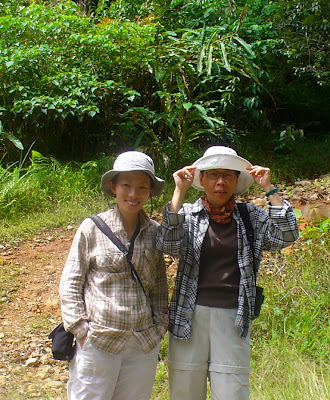 Yue Yun and I at the start of the tough Anaso Track of Lore Lindu National Park, Central Sulawesi.
Also, these trans migrants brought with them their religions. Flores is largely Catholic, Timor is a mix of Catholic and Protestant, while Sulawesi is Muslim. In truth, the perceived Christian / Muslim divide, is more accurately portrayed as a clash of cultures rather than religion. (eg ‘loud’ Bugis kids (from Sulawesi) vs quiet Flores children). Mr A said that much of the so called religious fighting between Muslims and Christians in Poso (Sulawesi) was actually not religious in nature, but was instead an ethnic war between the locals (Muslim), aided by hardliners from Java, and newcomers from Flores and Timor (Christian/Catholics), helped by largely Australian links. However, he qualified that this view is but a rumour and a taboo topic at that.
Mr A said that there was also an economically driven reason why some Indonesians choose to work in ‘ulu’ (remote) places. Coming from more advanced cities (eg. Bali), they tend to have better skill sets compared to the locals, making them more employable. If they were to remain in their home cities, they would lower their chances of finding well-paying jobs because of stiff competition and overpopulation. This also explains why many Indonesian Chinese set up shops in ulu places, because there is hardly any competition there (something I observed and originally puzzled about in Indonesia). For example, we were well treated by an Indonesian Chinese in remote Mborong (near Kisol, Flores), where the 50-year old shopkeeper attempted to speak to us in rusty Mandarin, and offered us a shaded place to sit while we waited for our onward bus to Labuan Bajo.
Overseas workers are also part and parcel of the Indonesian social fabric. We met a guy who was on his way to Dubai for a 3-year work stint in a 5-star hotel there, and a lady who once worked as a maid in Singapore. These folks were warm and helpful, totally refuting my misperceptions that Indonesia could be a breeding ground for terrorists, at least not in the remote places that we went to. Essentially, throughout our sojourn in these remote islands, where tourists are few and far between, we experienced nothing but friendliness.
Mr A said that there was also an economically driven reason why some Indonesians choose to work in ‘ulu’ (remote) places. Coming from more advanced cities (eg. Bali), they tend to have better skill sets compared to the locals, making them more employable. If they were to remain in their home cities, they would lower their chances of finding well-paying jobs because of stiff competition and overpopulation. This also explains why many Indonesian Chinese set up shops in ulu places, because there is hardly any competition there (something I observed and originally puzzled about in Indonesia). For example, we were well treated by an Indonesian Chinese in remote Mborong (near Kisol, Flores), where the 50-year old shopkeeper attempted to speak to us in rusty Mandarin, and offered us a shaded place to sit while we waited for our onward bus to Labuan Bajo.
Overseas workers are also part and parcel of the Indonesian social fabric. We met a guy who was on his way to Dubai for a 3-year work stint in a 5-star hotel there, and a lady who once worked as a maid in Singapore. These folks were warm and helpful, totally refuting my misperceptions that Indonesia could be a breeding ground for terrorists, at least not in the remote places that we went to. Essentially, throughout our sojourn in these remote islands, where tourists are few and far between, we experienced nothing but friendliness.
We covered about 15 birding sites in all. Each of the four islands had mountains for us to scale (Bedugul, Gunung Mutis, Poco Ranaka and Rorekatimbu), allowing us access to the montane species. I personally felt very worn and exhausted by our daily schedule, where most days we were up at 3am to take a 1 hour ojek ride to the birding site, arriving just before daybreak at 5am. Most nights, we put in only 3 to 4 hours of sleep. We made up for this sleep deprivation by taking siestas in the field, lying on the dirt paths to catch 40 winks, hat over our eyes, heads propped up on our backpacks. Our rewards were the birds. Check out my full bird list and read the thrills of seeing each one of them.
Birding Sites
Birding Sites
1. Bali - Celu Decantation Ponds, Nusa Dua
Sewage ponds near Club Med
2. Bali - Uluwatu
70m high cliffs with crashing surf
Sewage ponds near Club Med
2. Bali - Uluwatu
70m high cliffs with crashing surf
3. Bali - Bedugul Botanical Gardens
Montane forest
Montane forest
4. West Timor - Camplong
Lowland forest
Lowland forest
5. West Timor - Gunung Mutis (Fatumnasi)
Montane forest (mostly Eucalyptus urophylla trees)
Montane forest (mostly Eucalyptus urophylla trees)
6. West Timor - Bipolo, 55km from Kupang
Lowland forest
7. Flores - Danau Ranamese, 22km from Ruteng
Montane forest around Lake
Montane forest around Lake
8. Flores - Poco Ranaka, 7km from Ruteng
Montane forest around Flores' highest active volcano
Montane forest around Flores' highest active volcano
9. Flores - Kisol
Lowland forest
Lowland forest
10. Flores - Puarlolo Telkom Station, 33km fr Labuan Bajo
Lower montane forest
Lower montane forest
11. Flores - Potawangka, 13km from Labuan Bajo
Lower montane forest
Lower montane forest
12. Sulawesi - Lore Lindu National Park (Anaso Track)
Montane forest
Montane forest
13. Sulawesi - Wuasa, 15km from Anaso Track
Lower montane forest, paddyfields
Lower montane forest, paddyfields
14. Sulawesi - Karaenta, near Palu in the south
Noontime birding - very very unproductive
Noontime birding - very very unproductive
15. Sulawesi - Lake Tambing, 2km from Anaso Track
Lower montane forest
Lower montane forest
Annotated Bird List in Full
1 Great Frigatebird Fregata minor, Uluwatu, L1
Warded off the infamous Uluwatu monkeys to catch this gem soar in over the crashing surf and majestic cliffs, just before sunset at 6pm.
Warded off the infamous Uluwatu monkeys to catch this gem soar in over the crashing surf and majestic cliffs, just before sunset at 6pm.
2 Little Egret Egretta garzetta, Celu
Black-footed local residents, amongst yellow-footed migrants
3 Pacific Reef Egret Egretta sacra, Uluwatu
Another fly-by over the cliffs of Bali
4 Purple Heron Ardea purpurea, Celu, Lore Lindu
5 Great Egret Ardea alba,Celu
6 Intermediate Egret Ardea intermedia, Celu
7 Cattle Egret Ardea ibis, Bali/Wallacea
Found in paddies throughout Wallacea & Bali
8 Javan Pond-Heron Ardeola speciosa, Celu, L2
Lots of waterbirds on the various 'islands' at the extensive sewage ponds of Celu, without the accompanying sewage pong, surprisingly.
Black-footed local residents, amongst yellow-footed migrants
3 Pacific Reef Egret Egretta sacra, Uluwatu
Another fly-by over the cliffs of Bali
4 Purple Heron Ardea purpurea, Celu, Lore Lindu
5 Great Egret Ardea alba,Celu
6 Intermediate Egret Ardea intermedia, Celu
7 Cattle Egret Ardea ibis, Bali/Wallacea
Found in paddies throughout Wallacea & Bali
8 Javan Pond-Heron Ardeola speciosa, Celu, L2
Lots of waterbirds on the various 'islands' at the extensive sewage ponds of Celu, without the accompanying sewage pong, surprisingly.
9 Striated Heron Butorides striatus, Celu
Fishing silently and stealthily as usual
10 Black-crowned Night Heron Nycticorax Nycticorax, Celu
11 Little Pied Cormorant Phalacrocorax melanoleucos, Celu, L3
Drying their wings in typical cormorant fashion while perched on tree tops (8am). 1st visit - approx 30 individuals. 2nd visit - 15 individuals, huddled together under a shady tree.
12 Barred Honey-Buzzard Pernis celebensis, Tambing, L4
A fly-by on the highlands lake.
13 Brahminy Kite Haliastur indus, Celu, LabuanBajo
Bali has lots of man-made kites fluttering in the heavens, looking deceptively like raptors.The Brahminy at LBJ was soaring over the seas.
14 White-bellied Sea-Eagle Haliaeetus leucogaster, LabuanBajo
A juvenile soaring over the pretty seas of LBJ
15 Short-toed Eagle Circaetus gallicus, Bipolo, L5
Spotted by my ojek drivers (who had nothing to do while waiting 6 hours for us). The eagle was perched on a bare tree top. It also provided soaring views over the forest, showing off its broad wingspan.
Fishing silently and stealthily as usual
10 Black-crowned Night Heron Nycticorax Nycticorax, Celu
11 Little Pied Cormorant Phalacrocorax melanoleucos, Celu, L3
Drying their wings in typical cormorant fashion while perched on tree tops (8am). 1st visit - approx 30 individuals. 2nd visit - 15 individuals, huddled together under a shady tree.
12 Barred Honey-Buzzard Pernis celebensis, Tambing, L4
A fly-by on the highlands lake.
13 Brahminy Kite Haliastur indus, Celu, LabuanBajo
Bali has lots of man-made kites fluttering in the heavens, looking deceptively like raptors.The Brahminy at LBJ was soaring over the seas.
14 White-bellied Sea-Eagle Haliaeetus leucogaster, LabuanBajo
A juvenile soaring over the pretty seas of LBJ
15 Short-toed Eagle Circaetus gallicus, Bipolo, L5
Spotted by my ojek drivers (who had nothing to do while waiting 6 hours for us). The eagle was perched on a bare tree top. It also provided soaring views over the forest, showing off its broad wingspan.
16 Spotted Harrier Circus assimilis, Wuasa, L6
Only Harrier in this region. Quartering flight over the paddies just outside the Mona Lisa Penginapan.
17 Black Eagle Ictinaetus malayensis, Lore Lindu, L7
A nice finish to Day 1 of birding the Anaso Track, soared in at almost eye-level just as we reached the bottom of the mountain.
18 Bonelli's Eagle Hieraaetus fasciatus, Ranaka, L8
Amazing close-up eye-level views of this beauty at the heady heights of Poco Ranaka, about 6km from the start. It seemed attracted to the vocalisations of the Bare-throated Whistler, almost crashing into the tree where the whistlers were perched. The summit is at the 9km marker.
19 Sulawesi Hawk-Eagle Spizaetus lanceolatus (E), Lore Lindu, L9
Lots of tantalizing calls from over the hill, followed by a quick fly-by for a satisfying conclusion.
20 Variable Goshawk Accipiter novaehollandiae, Kisol, L10
Flew in with a huge lizard dangling from its beak while we were on the way to the Kisol forest at Poco Ndeki. Landed on a tree to finish off its kill.
21 Spotted Kestrel Falco moluccensis, Mutis, Bipolo, Lore Lindu, L11
First spotted on Gunung Mutis, engaged in a frenzied flight as it chased after huge insects. In Sulawesi, it appeared to be common, often found perched atop bare trees along the 15-km journey between Wuasa and the Anaso Track.
22 Australian Hobby Falco longipennis, Mutis, L12
We witnessed the exciting spectacle of the hobby chasing after an Olive-shouldered Lorikeet, with the Lorikeet yelping at top volume! Thankfully, the Lori escaped! My most dramatic raptor chase to date.
23 Peregrine Falcon Falco peregrinus, Ranamese
The falcon was being chased by a Bonelli's eagle.
24 Pacific Black Duck Anas superciliosa, Ranamese, L13
Floating far away on the caldera, about 10-12 ducks. Black blobs.
25 Sunda Teal Anas gibberifrons, Celu, L14
Scattered rafts of 2-6 ducks, common as you walk into the interior of Celu, just before taking the loop to the other side. Also saw them waddling around.
26 Wandering Whistling Duck Dendrocygna arcuata, Celu
27 Green Junglefowl Gallus varius, Ranamese, Ranaka, Kisol,Potawangka, L15
Our most exciting bashing and tracking effort, even more so than getting the Elegant Pitta. Stunning close-up views of the male and its mate with feathers glittering silver in the sun as it moved about in the thick undergrowth. Its call is quite different from the Red JF, sounding almost primate-like. But it still makes the clucking sounds typical of a chicken as it pecks the ground. Got it again on Ranaka, this time on the trail itself, giving several good views.
28 White-breasted Waterhen Amaurornis phoenicurus, Celu
29 Common Redshank Tringa nebularia, Celu
30 Grey-tailed Tattler Heteroscelus brevipes, Celu
31 Rock Pigeon Columba livia, Everywhere
32 Metallic Pigeon Columba vitiensis, Ranamese, Ranaka, L16
Good views of one bird perched 10m away and up. Greenish tint on feathers.
29 Common Redshank Tringa nebularia, Celu
30 Grey-tailed Tattler Heteroscelus brevipes, Celu
31 Rock Pigeon Columba livia, Everywhere
32 Metallic Pigeon Columba vitiensis, Ranamese, Ranaka, L16
Good views of one bird perched 10m away and up. Greenish tint on feathers.
33 Island Collared Dove Streptopelia bitorquata, Celu, L17
Quite a few around, prominent collar.
34 Spotted Dove Streptopelia chinensis, All 4 islands, Mutis
35 Ruddy Cuckoo-dove Macropygia emiliana, Ranaka, L18
36 Barred Cuckoo-dove Macropygia unchall, Bedugul, L19
Feeding amongst other birds.
37 Brown Cuckoo-Dove Macropygia amboinensis, Lore Lindu, L20
38 Little Cuckoo-Dove Macropygia ruficeps, Ranamese
39 Emerald Dove Chalcophaps indica, Camplong, Ranaka, Kisol (h)
Found one walking on the trail at Camplong. Rather bold. Potential spilt.
40 Sulawesi Ground-Dove Gallicolumba tristigmata (E), Lore Lindu, L21
While seated on a mossy log in the forest, waiting for the Geomalia to appear, this bird startled all of us by popping into view through the trees. It made a quick U-turn when it saw us, flapping a little and running on the ground to get away. Saw its reddish (purple) eye-ring. Ding Li thought it could be a Grey-headed Imperial Pigeon at first. 35cm.
41 Green Imperial-Pigeon Ducula aenea, Kisol, Potawangka
42 White-bellied Imperial-Pigeon Ducula forsteni (E), Lore Lindu, L22
Multiple views of this beauty. Even saw it perched on a bare tree on the way back to town, spotted by my 'Harley Davidson' pai-kia ojek driver. It bowed low to create the booming call typical of imperial pigeons. Fantastic!
43 Timor Imperial Pigeon Ducula cineracea (h), Mutis
Frustrating search amongst the Eucalyptus urophylla forests produced nothing. Ding Li suspects it could be found higher up in the mossy elfin forest, which we didn't have time to explore.
44 Grey-headed Imperial-Pigeon Ducula radiata (E) , Lore Lindu, L23
Good views, thanks to Ding, who found one bird perched obligingly for us to oogle at. Also had far away views of a necking couple (birds here are of a companionable nature), just after the Diabolical Nightjar ditch.
45 Pink-headed Imperial Pigeon Ducula rosacea, Bipolo, L24
A fleeting glimpse of the bird as it took off from a branch. I hate such views!
Quite a few around, prominent collar.
34 Spotted Dove Streptopelia chinensis, All 4 islands, Mutis
35 Ruddy Cuckoo-dove Macropygia emiliana, Ranaka, L18
36 Barred Cuckoo-dove Macropygia unchall, Bedugul, L19
Feeding amongst other birds.
37 Brown Cuckoo-Dove Macropygia amboinensis, Lore Lindu, L20
38 Little Cuckoo-Dove Macropygia ruficeps, Ranamese
39 Emerald Dove Chalcophaps indica, Camplong, Ranaka, Kisol (h)
Found one walking on the trail at Camplong. Rather bold. Potential spilt.
40 Sulawesi Ground-Dove Gallicolumba tristigmata (E), Lore Lindu, L21
While seated on a mossy log in the forest, waiting for the Geomalia to appear, this bird startled all of us by popping into view through the trees. It made a quick U-turn when it saw us, flapping a little and running on the ground to get away. Saw its reddish (purple) eye-ring. Ding Li thought it could be a Grey-headed Imperial Pigeon at first. 35cm.
41 Green Imperial-Pigeon Ducula aenea, Kisol, Potawangka
42 White-bellied Imperial-Pigeon Ducula forsteni (E), Lore Lindu, L22
Multiple views of this beauty. Even saw it perched on a bare tree on the way back to town, spotted by my 'Harley Davidson' pai-kia ojek driver. It bowed low to create the booming call typical of imperial pigeons. Fantastic!
43 Timor Imperial Pigeon Ducula cineracea (h), Mutis
Frustrating search amongst the Eucalyptus urophylla forests produced nothing. Ding Li suspects it could be found higher up in the mossy elfin forest, which we didn't have time to explore.
44 Grey-headed Imperial-Pigeon Ducula radiata (E) , Lore Lindu, L23
Good views, thanks to Ding, who found one bird perched obligingly for us to oogle at. Also had far away views of a necking couple (birds here are of a companionable nature), just after the Diabolical Nightjar ditch.
45 Pink-headed Imperial Pigeon Ducula rosacea, Bipolo, L24
A fleeting glimpse of the bird as it took off from a branch. I hate such views!
46 Dark-backed Imperial Pigeon Ducula lacernulata, Bedugul, Ranaka L25
Calls of this bird reverberates throughout Bedugul and Ranaka, but good views are hard to come by especially at Bedugul. Was lucky to see it well in both places.
47 Black-backed Fruit-dove Ptilinopus cinctus (E), Mutis, Bipolo, Ranaka, L26
Gorgeous views as we rounded the corner to check out its v loud call (which we thought could be the Timor Imp). This was the start of a sudden spurt of lifers within 20 minutes of each other (Black-backed Fruit Dove, Wallacean Drongo, Olive-shouldered Parrot, Australian Hobby).
48 Red-eared Fruit-Dove Ptilinopus fischeri (E), Lore Lindu, L27
Surprisingly common. Usually found in pairs feeding on figging trees.
49 Black-naped Fruit-Dove Ptilinopus melanospila, Potawangka, L28
My favourite fruit-dove. Was taken in by its colours, seen close-up and in perfect light no less, when I was alone in Potawangka (13km marker from LBJ) at the start of the day. Found a pair of these birds. Loved its white head, green body, yellow & red vent. Ding Li had motorcycled into the interior to check out the forest there, but came back to look for moi 1/2 hr later.
50 Rose-crowned Fruit-Dove Ptilinopus regina, Camplong, Bipolo, L29
Saw a lone female, backlighted on the 1st day. On my own the 2nd morning, while Ding Li went for mass, I had excellent views of a pair (male & female), as they perched on the white flower tree besides the figging tree. Only complaint is that my hands shook a lot while looking at them at almost a vertical angle.
Calls of this bird reverberates throughout Bedugul and Ranaka, but good views are hard to come by especially at Bedugul. Was lucky to see it well in both places.
47 Black-backed Fruit-dove Ptilinopus cinctus (E), Mutis, Bipolo, Ranaka, L26
Gorgeous views as we rounded the corner to check out its v loud call (which we thought could be the Timor Imp). This was the start of a sudden spurt of lifers within 20 minutes of each other (Black-backed Fruit Dove, Wallacean Drongo, Olive-shouldered Parrot, Australian Hobby).
48 Red-eared Fruit-Dove Ptilinopus fischeri (E), Lore Lindu, L27
Surprisingly common. Usually found in pairs feeding on figging trees.
49 Black-naped Fruit-Dove Ptilinopus melanospila, Potawangka, L28
My favourite fruit-dove. Was taken in by its colours, seen close-up and in perfect light no less, when I was alone in Potawangka (13km marker from LBJ) at the start of the day. Found a pair of these birds. Loved its white head, green body, yellow & red vent. Ding Li had motorcycled into the interior to check out the forest there, but came back to look for moi 1/2 hr later.
50 Rose-crowned Fruit-Dove Ptilinopus regina, Camplong, Bipolo, L29
Saw a lone female, backlighted on the 1st day. On my own the 2nd morning, while Ding Li went for mass, I had excellent views of a pair (male & female), as they perched on the white flower tree besides the figging tree. Only complaint is that my hands shook a lot while looking at them at almost a vertical angle.
51 Pink-necked Green Pigeon Treron vernans, Celu
52 Grey-cheeked Green Pigeon Treron griseicauda, Bedugul, L30
Saw it well, on the slopes of Bedugul, the 1st of 4 mountains that we climbed.
52 Grey-cheeked Green Pigeon Treron griseicauda, Bedugul, L30
Saw it well, on the slopes of Bedugul, the 1st of 4 mountains that we climbed.
53 Weber’s Lorikeet Trichoglossus haematodus weberi (E), (formerly Rainbow Lorikeet), Ranaka, L31
Had a pair, backlighted. BVD.
Had a pair, backlighted. BVD.
54 Yellow-and-green Lorikeet Trichoglossus flavoviridis (E), Lore Lindu L32
Fly-bys only.
55 Olive-headed Lorikeet Trichoglossus euteles (E), Mutis, L33
Very common and noisy on Gunung Mutis.
56 Golden-mantled Racquet-tail Prioniturus platurus (E), Lore Lindu, L34
Fly-bys only. At least I saw its racquet. My first racquet-tail, after missing the one in Palawan.
57 Great-billed Parrot Tanygnathus megalorynchos, Potawangka, L35
Lucky to see this big bird, perched and flying. Distinctive huge red bill. Distracted Ding Li from his Pitta pursuit to look at it. It flew right over us.
Very common and noisy on Gunung Mutis.
56 Golden-mantled Racquet-tail Prioniturus platurus (E), Lore Lindu, L34
Fly-bys only. At least I saw its racquet. My first racquet-tail, after missing the one in Palawan.
57 Great-billed Parrot Tanygnathus megalorynchos, Potawangka, L35
Lucky to see this big bird, perched and flying. Distinctive huge red bill. Distracted Ding Li from his Pitta pursuit to look at it. It flew right over us.
58 Olive-shouldered Parrot Aprosmictus jonquillaceus, Mutis, Bipolo, L36
Much bigger than the Olive-headed Lorikeets, and far less common. Two very good close-up views, reds on shoulder very prominent.
59 Oriental (Sunda/Horsfield's) Cuckoo Cuculus saturatus, Bedugul, Flores, L37
After hearing its call all morning at Bedugul, Ding's sharp eyes picked out a lone bird, perched close enough to score me another lifer! Unblocked views.
60 Plaintive Cuckoo Cacomantis merulinus (h), Celu, Bedugul, Wuasa
Its 'this old man' call brings back good memories of The Last Frontier resort in Sabang, Palawan.
61 Rusty-breasted Cuckoo Cacomantis sepulcralis
Lore Lindu, Bedugul, Timor, Flores
Had a poor view of this bird at Lake Tambing.
L38
Much bigger than the Olive-headed Lorikeets, and far less common. Two very good close-up views, reds on shoulder very prominent.
59 Oriental (Sunda/Horsfield's) Cuckoo Cuculus saturatus, Bedugul, Flores, L37
After hearing its call all morning at Bedugul, Ding's sharp eyes picked out a lone bird, perched close enough to score me another lifer! Unblocked views.
60 Plaintive Cuckoo Cacomantis merulinus (h), Celu, Bedugul, Wuasa
Its 'this old man' call brings back good memories of The Last Frontier resort in Sabang, Palawan.
61 Rusty-breasted Cuckoo Cacomantis sepulcralis
Lore Lindu, Bedugul, Timor, Flores
Had a poor view of this bird at Lake Tambing.
L38
62 Gould's Bronze-Cuckoo Chrysococcyx russatus
Camplong
Got a juvenile, without the stripes on its belly.
L39
Camplong
Got a juvenile, without the stripes on its belly.
L39
63 Black-billed Koel Eudynamys melanorhyncha (E) (h)
Lore Lindu
64 Yellow-billed Malkoha Phaenicophaeus calyorhynchus (E)
Lore Lindu
Wow, a true trophy. Was v pleased to see so many of these biggies flying and perching at close range. Found them at around 1030am in the morning, on the road towards Palu. Even took pictures of one bird. That morning was a dark one, as our ojek drivers stood us up, because of a hang-over fueled by our 220,000 Rp fee for 3 days of their services. We only managed to get another set of 3 drivers at 10am, having wasted 5 1/2 hours waiting around since 430am. Well, at least we enjoyed a slow morning with a proper breakfast and good tea at a roadside warung.
L40
Lore Lindu
64 Yellow-billed Malkoha Phaenicophaeus calyorhynchus (E)
Lore Lindu
Wow, a true trophy. Was v pleased to see so many of these biggies flying and perching at close range. Found them at around 1030am in the morning, on the road towards Palu. Even took pictures of one bird. That morning was a dark one, as our ojek drivers stood us up, because of a hang-over fueled by our 220,000 Rp fee for 3 days of their services. We only managed to get another set of 3 drivers at 10am, having wasted 5 1/2 hours waiting around since 430am. Well, at least we enjoyed a slow morning with a proper breakfast and good tea at a roadside warung.
L40
65 Lesser Coucal Centropus bengalensis
Bipolo
On the walk to the paddies with the ex-Indonesian maid who worked in Singapore.
66 Barred Eagle Owl Bubo sumatranus
Bedugul
Was absolutely delighted to spot this terrific raptor swooping into view in the dim light of Bedugul forest, at around 730am in the morning. Was relieved to find it perched in the shadows, and when it finally turned its head, I was oh-so-happy to see that it was an eared owl. After looking directly at me for a while, the owl flew past us, crossing the trail to the other side of the forest. All thoughts of the babbler that we were chasing were lost as I reveled in the after-glow of the owl sighting. One of my top birds for this trip, an owl in daylight!
L41
Bipolo
On the walk to the paddies with the ex-Indonesian maid who worked in Singapore.
66 Barred Eagle Owl Bubo sumatranus
Bedugul
Was absolutely delighted to spot this terrific raptor swooping into view in the dim light of Bedugul forest, at around 730am in the morning. Was relieved to find it perched in the shadows, and when it finally turned its head, I was oh-so-happy to see that it was an eared owl. After looking directly at me for a while, the owl flew past us, crossing the trail to the other side of the forest. All thoughts of the babbler that we were chasing were lost as I reveled in the after-glow of the owl sighting. One of my top birds for this trip, an owl in daylight!
L41
67 Diabolical Nightjar (E) Eurostopodus diabolicus
Lore Lindu
Yue Yun's favourite bird. Ding Li made an all-important call to Bingwen the night before to get pretty vague directions to the nightjar. That morning, he looked into every ditch he could find, and hey presto, unveiled a pair of companionable birds sitting tight in a ditch at the first ridge right after the 2 bridges. Thereafter, we visited the pair each time we passed the ditch. Only once did one of them snare at us, in response to me standing up suddenly. Was amused with its wide, red jaws. These birds are also very sensitive to audio waves, opening and closing their eyes to various degrees in response to fluctuating ambient sounds.
L42
Lore Lindu
Yue Yun's favourite bird. Ding Li made an all-important call to Bingwen the night before to get pretty vague directions to the nightjar. That morning, he looked into every ditch he could find, and hey presto, unveiled a pair of companionable birds sitting tight in a ditch at the first ridge right after the 2 bridges. Thereafter, we visited the pair each time we passed the ditch. Only once did one of them snare at us, in response to me standing up suddenly. Was amused with its wide, red jaws. These birds are also very sensitive to audio waves, opening and closing their eyes to various degrees in response to fluctuating ambient sounds.
L42
68 Savanna Nightjar Caprimulgus affinis (h)
Kuta
Heard one calling and saw it flying around (without bins) at Taman Ayu II, while waiting outside our room for Yue Yun and Margaret to arrive from Ubud on 26/5/07. At Bendesa Accomodations, when we visited Bali for the 3rd time as a transit stop, we heard it again. Searched for it at the grassy patch near the hotel but to no avail. Calls accompanies that of the Tokay (lizard).
69 Glossy Swiftlet Collacalia esculenta
Everywhere
70 Linchi Swiftlet Collacalia linchi
Nusa Dua
Zipping about around Puri Tanjong Hotel where we stayed. Looks like the Glossy (White-bellied) swiftlet.
L43
Kuta
Heard one calling and saw it flying around (without bins) at Taman Ayu II, while waiting outside our room for Yue Yun and Margaret to arrive from Ubud on 26/5/07. At Bendesa Accomodations, when we visited Bali for the 3rd time as a transit stop, we heard it again. Searched for it at the grassy patch near the hotel but to no avail. Calls accompanies that of the Tokay (lizard).
69 Glossy Swiftlet Collacalia esculenta
Everywhere
70 Linchi Swiftlet Collacalia linchi
Nusa Dua
Zipping about around Puri Tanjong Hotel where we stayed. Looks like the Glossy (White-bellied) swiftlet.
L43
71 Collared Kingfisher Todiramphus chloris
Celu, Wuasa
72 Javan Kingfisher Halcyon cyanoventris
Ubud, Bedugul
At the Campuhan Ridge Walk in Ubud, I scanned and found one bird perched in a distal tree, after Ding Li spotted the bird flying in. Other than this find, the walk was a dismal one, turning up only munias and more art shops. Close-up views at the gates of the Bedugul Botanical Gardens, as well as fly-by views along the drive back to Kuta.
L44
Celu, Wuasa
72 Javan Kingfisher Halcyon cyanoventris
Ubud, Bedugul
At the Campuhan Ridge Walk in Ubud, I scanned and found one bird perched in a distal tree, after Ding Li spotted the bird flying in. Other than this find, the walk was a dismal one, turning up only munias and more art shops. Close-up views at the gates of the Bedugul Botanical Gardens, as well as fly-by views along the drive back to Kuta.
L44
73 Sacred Kingfisher Halcyon sancta
Celu, Kisol
Close-up views of 2 birds. Kisol - found it within the seminary (sacred) grounds.
L45
Celu, Kisol
Close-up views of 2 birds. Kisol - found it within the seminary (sacred) grounds.
L45
74 Small Blue Kingfisher Alcedo coerulescens
Celu
I love this blue jewel. Common at Celu, brightening up the drab environment with flashes of azure.
L46
Celu
I love this blue jewel. Common at Celu, brightening up the drab environment with flashes of azure.
L46
75 Cinnamon-banded Kingfisher Todiramphus australasia (h)
Camplong, Bipolo
Our luck with kingfishers was sorely lacking at both W Timor and Flores, despite cutting ourselves on thorny vines caused by bashing after them on numerous occasions. We were very close to seeing both Cinnamon-banded and White-rumped, but all we managed was a black bird fly tauntingly away. Most irksome.
76 White-rumped Kingfisher Caridonax fulgidus (h)
Kisol, Puarlolo, Potawangka
77 Red Knobbed Hornbill Aceros cassidix E
Wuasa
The evening ride home on the 2nd day of birding Anaso produced a fly-by hornbill. Luckily, I managed to get off my bike on time to binocular it well. Good but far-away perched views of one hornbill as it fed on palm fruits. Also saw its mate fly-in. Very happy to get the hornbill, a bird that is more common at lower elevations, esp at Tangkoko NP.
L47
Camplong, Bipolo
Our luck with kingfishers was sorely lacking at both W Timor and Flores, despite cutting ourselves on thorny vines caused by bashing after them on numerous occasions. We were very close to seeing both Cinnamon-banded and White-rumped, but all we managed was a black bird fly tauntingly away. Most irksome.
76 White-rumped Kingfisher Caridonax fulgidus (h)
Kisol, Puarlolo, Potawangka
77 Red Knobbed Hornbill Aceros cassidix E
Wuasa
The evening ride home on the 2nd day of birding Anaso produced a fly-by hornbill. Luckily, I managed to get off my bike on time to binocular it well. Good but far-away perched views of one hornbill as it fed on palm fruits. Also saw its mate fly-in. Very happy to get the hornbill, a bird that is more common at lower elevations, esp at Tangkoko NP.
L47
78 Purple-bearded Bee-eater Meropogon forsteni (E)
Lore Lindu
We were charmed by this curious but pretty bearded bee-eater. We saw it everyday during our 5 days birding Anaso, always perched on an exposed branch, happily wagging its tail. In all, we found 3 pairs, with suspected nesting in the soft sands of the ravine at both bridges. I even photographed a pair mating!!!
L48
Lore Lindu
We were charmed by this curious but pretty bearded bee-eater. We saw it everyday during our 5 days birding Anaso, always perched on an exposed branch, happily wagging its tail. In all, we found 3 pairs, with suspected nesting in the soft sands of the ravine at both bridges. I even photographed a pair mating!!!
L48
79 Blue-tailed Bee-eater Merops philippinus
Celu
80 Rainbow Bee-eater Merops ornatus
Bipolo, Kisol
Good views while waiting for the White-rumped KF to show, somewhere inside the Kisol forest. Saw the distinctive black throat patch.
L49
Celu
80 Rainbow Bee-eater Merops ornatus
Bipolo, Kisol
Good views while waiting for the White-rumped KF to show, somewhere inside the Kisol forest. Saw the distinctive black throat patch.
L49
81 Sulawesi Pygmy Woodpecker Dendrocopos temminckii (E)
Lore Lindu
Cute bird. Lighter brown than the Sunda Pygmy. Accompanies bird waves.
L50
Lore Lindu
Cute bird. Lighter brown than the Sunda Pygmy. Accompanies bird waves.
L50
82 Sunda Pygmy Woodpecker Dendrocopos moluccensis
Ranamese, Ranaka, Kisol, Puarlolo
83 Fulvous-breasted Woodpecker Dendrocopos macei
Celu
Much bigger than the Sunda at 16cm, with reddish crown. Good views with Dr Hsu Chia Chi, on my first birding foray of the trip. Coincidentally, Lena and I had bumped into him at the Changi airport.
L51
Ranamese, Ranaka, Kisol, Puarlolo
83 Fulvous-breasted Woodpecker Dendrocopos macei
Celu
Much bigger than the Sunda at 16cm, with reddish crown. Good views with Dr Hsu Chia Chi, on my first birding foray of the trip. Coincidentally, Lena and I had bumped into him at the Changi airport.
L51
84 Crimson-winged Woodpecker Picus puniceus (h)
Bedugul
85 Orange-fronted Barbet Magalaima armillaris (E)
Bedugul
One of the rewards for climbing Bedugul mountains. Close-up but fleeting views.
L52
Bedugul
85 Orange-fronted Barbet Magalaima armillaris (E)
Bedugul
One of the rewards for climbing Bedugul mountains. Close-up but fleeting views.
L52
86 Elegant Pitta Pitta elegans (E)
Potawangka
This was one chase that paid handsome rewards. Two birds were calling, one near me, and one near Ding Li, but both failed to show. Then the calls started again on the other side of the forest. After some bashing, Ding Li announced his find with a loudly exclaimed 'Oh My Gosh!'. Not wanting to crash forward and scare away the bird, I tried my best to see the bird from where I was (blocked by Ding). Luckily, Ding found it for me a few minutes later, again perched and calling from a tree, and not on the ground as we had supposed it to be. We were very pleased with Potawangka for producing the Pitta. Our first and only time hearing the bird call. Potawangka appeared to be very degraded and unpromising at first.
L53
Potawangka
This was one chase that paid handsome rewards. Two birds were calling, one near me, and one near Ding Li, but both failed to show. Then the calls started again on the other side of the forest. After some bashing, Ding Li announced his find with a loudly exclaimed 'Oh My Gosh!'. Not wanting to crash forward and scare away the bird, I tried my best to see the bird from where I was (blocked by Ding). Luckily, Ding found it for me a few minutes later, again perched and calling from a tree, and not on the ground as we had supposed it to be. We were very pleased with Potawangka for producing the Pitta. Our first and only time hearing the bird call. Potawangka appeared to be very degraded and unpromising at first.
L53
87 Striated Swallow Hirundo striolata
Labuan Bajo
One bird flying amidst the Glossy Swiftlets, opposite Hotel Rima where we stayed.
88 Tree Martin Hirundo nigricans
Bipolo
Swooping over the paddy fields 1km west of Bipolo forest.
L54
Labuan Bajo
One bird flying amidst the Glossy Swiftlets, opposite Hotel Rima where we stayed.
88 Tree Martin Hirundo nigricans
Bipolo
Swooping over the paddy fields 1km west of Bipolo forest.
L54
89 Richard's Pipit Anthus novaeseelandiae
Mutis
At first, Gunung Mutis was very quiet. Seeing the common Richard's Pipit made us even more glum. Imagine coming all the way here just to see a pipit. The birds only started pouring in much later in the morning.
90 Javan Cuckoo-shrike Coracina javensis (h)
Bedugul
91 Wallacean Cuckoo-shrike Coracina personata (E)
Camplong, Ranamese, Mutis
Common in the Lesser Sundas.
L55
Mutis
At first, Gunung Mutis was very quiet. Seeing the common Richard's Pipit made us even more glum. Imagine coming all the way here just to see a pipit. The birds only started pouring in much later in the morning.
90 Javan Cuckoo-shrike Coracina javensis (h)
Bedugul
91 Wallacean Cuckoo-shrike Coracina personata (E)
Camplong, Ranamese, Mutis
Common in the Lesser Sundas.
L55
92 Cerulean Cuckoo-shrike Coracina temminckii (E)
Lore Lindu
Common at lower elevations of Anaso. Always a flock of 5-6 birds, mixed with other big birds like the Piping Crow, Fiery-browed Mynas, Malias, Sulawesi Thrush etc.
L56
Lore Lindu
Common at lower elevations of Anaso. Always a flock of 5-6 birds, mixed with other big birds like the Piping Crow, Fiery-browed Mynas, Malias, Sulawesi Thrush etc.
L56
93 Pygmy Cuckoo-shrike Coracina abbotti (E)
Lore Lindu
A contrast in colours. Its red eyes stand out on its pied body. Fairly common.
L57
Lore Lindu
A contrast in colours. Its red eyes stand out on its pied body. Fairly common.
L57
94 Pale-shouldered Cicadabird Coracina dohertyi (E)
Ranamese
Saw it well, in the forest of Ranamese when we followed one of the many mini paths off the main road.
L58
Ranamese
Saw it well, in the forest of Ranamese when we followed one of the many mini paths off the main road.
L58
95 Sulawesi Cicadabird Coracina morio (E)
Lore Lindu
Yue Yun and I determined that it was grey-white, and not bluish, to make sure that we had not mis-IDed the Cerulean CS. Got it only at the higher elevations near the summit.
L59
Lore Lindu
Yue Yun and I determined that it was grey-white, and not bluish, to make sure that we had not mis-IDed the Cerulean CS. Got it only at the higher elevations near the summit.
L59
96 Slender-billed Cuckooshrike Coracina tenuirostris
Lore Lindu
L60
Lore Lindu
L60
97 Flores Minivet Pericrocotus lansbergei (E)
Ranamese, Ranaka, Kisol
Pretty red thing, saw it first in a low bush. Common throughout Flores.
L61
Ranamese, Ranaka, Kisol
Pretty red thing, saw it first in a low bush. Common throughout Flores.
L61
98 Scarlet Minivet Pericrocotus falmmeus
Bedugul
99 Common Iora Aegithina tiphia (h)
Celu
100 Sooty-headed Bulbul Pycnonotus aurigaster
Nusa Dua
Yellow-vented form.
101 Yellow-vented Bulbul Pycnonotus goiavier
Nusa Dua, Bedugul
Noisy gurgles, especially in the morning. Main street bird in Bali.
102 Ashy Drongo Dicrurus leucophaeus
Bedugul
103 Sulawesi Drongo Dicrurus montanus (E)
Lore Lindu
Common at lower elevations of Anaso. Saw one trying to steal a huge stick insect from a Cerulean Cuckoo-shrike.
L62
Bedugul
99 Common Iora Aegithina tiphia (h)
Celu
100 Sooty-headed Bulbul Pycnonotus aurigaster
Nusa Dua
Yellow-vented form.
101 Yellow-vented Bulbul Pycnonotus goiavier
Nusa Dua, Bedugul
Noisy gurgles, especially in the morning. Main street bird in Bali.
102 Ashy Drongo Dicrurus leucophaeus
Bedugul
103 Sulawesi Drongo Dicrurus montanus (E)
Lore Lindu
Common at lower elevations of Anaso. Saw one trying to steal a huge stick insect from a Cerulean Cuckoo-shrike.
L62
104 Wallacean Drongo Dicrurus densus (E)
Mutis, Ranamese, Ranaka, Kisol, Puarlolo, Potawangka
The only bird found by our guide (one of the sons or son-in-law of Pak Matius). Common throughout Wallacea. Always the first bird of the morning at Ranamese, just before daybreak, while waiting hopefully for the owls to show.
L63
Mutis, Ranamese, Ranaka, Kisol, Puarlolo, Potawangka
The only bird found by our guide (one of the sons or son-in-law of Pak Matius). Common throughout Wallacea. Always the first bird of the morning at Ranamese, just before daybreak, while waiting hopefully for the owls to show.
L63
105 Hair-crested Drongo Dicrurus hottentottus
Bedugul, Lore Lindu
White eyes differentiate it from the Sulawesi Drongo.
106 Malia Malia grata (E)
Lore Lindu
Great views of many Malias mixed with Malkohas on the road to Palu.
L64
Bedugul, Lore Lindu
White eyes differentiate it from the Sulawesi Drongo.
106 Malia Malia grata (E)
Lore Lindu
Great views of many Malias mixed with Malkohas on the road to Palu.
L64
107 Timor (Olive-brown) Oriole Oriolus melanotis (E)
Camplong, Bipolo
Definitely my jinx bird. Only got it after a long while, and only the female. Calls similar to the Black-naped.
L65
Camplong, Bipolo
Definitely my jinx bird. Only got it after a long while, and only the female. Calls similar to the Black-naped.
L65
108 Black-naped Oriole Oriolus chinensis
Celu, Puarlolo, Lore Lindu
109 Timor Figbird Sphecotheres viridis (E)
Camplong, Bipolo
Common on all figging trees. Always in huge numbers, predominantly females. Males look dashing with their red eye patches.
L66
Celu, Puarlolo, Lore Lindu
109 Timor Figbird Sphecotheres viridis (E)
Camplong, Bipolo
Common on all figging trees. Always in huge numbers, predominantly females. Males look dashing with their red eye patches.
L66
110 Piping Crow Corvus typicus (E)
Lore Lindu
My top trip bird!!! Unique and very beautiful. Especially love its wing beats as it flies from branch to branch, giving off a peculiar sound that is almost melodious. Calls are also most pleasing to the ears. Somehow or other, this crow makes me happy. I miss it already.
L67
Lore Lindu
My top trip bird!!! Unique and very beautiful. Especially love its wing beats as it flies from branch to branch, giving off a peculiar sound that is almost melodious. Calls are also most pleasing to the ears. Somehow or other, this crow makes me happy. I miss it already.
L67
111 Flores Crow Corvus florensis (E)
Kisol, Potawangka
Ding Li was almost rapturous when he saw this crow. I didn't see his fascination with crows till I experienced the beauty of the Piping Crow. The Flores Crow was just a smallish crow to me that gives off a human like cry, much like a baby's. Good views of a flock of 4-5 birds, at eye level. Very shy. Also present at Potawangka. Kisol produced only 2 new birds for us, the Flores Crow and the Black-fronted Flowerpecker, both of which we found later elsewhere.
L68
Kisol, Potawangka
Ding Li was almost rapturous when he saw this crow. I didn't see his fascination with crows till I experienced the beauty of the Piping Crow. The Flores Crow was just a smallish crow to me that gives off a human like cry, much like a baby's. Good views of a flock of 4-5 birds, at eye level. Very shy. Also present at Potawangka. Kisol produced only 2 new birds for us, the Flores Crow and the Black-fronted Flowerpecker, both of which we found later elsewhere.
L68
112 Large-billed Crow Corvus macrohynchos
Celu, Mutis
113 Great Tit Parus major
Bedugul, Ranamese, Ranaka
114 Horsfield's Babbler Trichastoma sepiarium
Bedugul
My first bashing attempt produced stunning views of the Horsfield's Babbler, which was perched barely 5m from me at waist-level. Good but brief views.
L69
Celu, Mutis
113 Great Tit Parus major
Bedugul, Ranamese, Ranaka
114 Horsfield's Babbler Trichastoma sepiarium
Bedugul
My first bashing attempt produced stunning views of the Horsfield's Babbler, which was perched barely 5m from me at waist-level. Good but brief views.
L69
115 Sulawesi Babbler Trichastoma celebense (E)
Lore Lindu
Brown and white bird that is most non-descript.
L70
Lore Lindu
Brown and white bird that is most non-descript.
L70
116 Chestnut-backed Scimitar Babbler Pomatorhinus montanus
Bedugul
A pair of these noisy beauties flew in at eye-level and close range for a few short seconds.
L71
Bedugul
A pair of these noisy beauties flew in at eye-level and close range for a few short seconds.
L71
117 Pygmy Wren-Babbler Pnoepyga pusilla (h)
Mutis, Ranamese, Ranaka
As elusive as its call is common. Didn't have time to bash after it, as priority had to be given to the endemics.
118 White-browed Shortwing Brachypteryx montana floris
Ranaka
Our mystery bird. The Flores race of the White-browed shortwing has a very long robin/chat-like tail that is often cocked, a greyish-blue back and greyish-white belly, with a prominent and long white eyebrow. Ding Li thought that we had stumbled upon a new species. Internet enquiries revealed otherwise. Got it as it hopped onto the trail for close to 1/2 a minute, while we were waiting for the Tawny-breasted Parrotfinch to make its appearance at the 5km point. Saw a female (brownish) bird on the trail too, on the way down. Ding Li immediately made a sketch of this bird in my notebook. Cool!
L72
Mutis, Ranamese, Ranaka
As elusive as its call is common. Didn't have time to bash after it, as priority had to be given to the endemics.
118 White-browed Shortwing Brachypteryx montana floris
Ranaka
Our mystery bird. The Flores race of the White-browed shortwing has a very long robin/chat-like tail that is often cocked, a greyish-blue back and greyish-white belly, with a prominent and long white eyebrow. Ding Li thought that we had stumbled upon a new species. Internet enquiries revealed otherwise. Got it as it hopped onto the trail for close to 1/2 a minute, while we were waiting for the Tawny-breasted Parrotfinch to make its appearance at the 5km point. Saw a female (brownish) bird on the trail too, on the way down. Ding Li immediately made a sketch of this bird in my notebook. Cool!
L72
119 Pied Bushchat Saxicola caprata
Camplong, Mutis, Bipolo
Common. Its prominent perch was the downfall of one female bird, which fell victim to the catapult. We IDed the dead bird as it dangled from the hands of a passing villager. Villagers, both adults and kids, apparently hunt these birds for fun.
120 White-bellied Chat Saxicola gutturalis
Camplong, Bipolo
Fairly common.
L73
Camplong, Mutis, Bipolo
Common. Its prominent perch was the downfall of one female bird, which fell victim to the catapult. We IDed the dead bird as it dangled from the hands of a passing villager. Villagers, both adults and kids, apparently hunt these birds for fun.
120 White-bellied Chat Saxicola gutturalis
Camplong, Bipolo
Fairly common.
L73
121 Orange-banded Thrush Zoothera peronii (E)
Camplong, Bipolo
The best bird for the Timor leg. Adult with juvenile, lurking by a rocky snail-filled gully. Flushed the bird the first day. Subsequently, we saw it everyday at around the same location.
L74
Camplong, Bipolo
The best bird for the Timor leg. Adult with juvenile, lurking by a rocky snail-filled gully. Flushed the bird the first day. Subsequently, we saw it everyday at around the same location.
L74
122 Sunda Whistling Thrush Myophonus glaucinus
Bedugul
Reminds me of the Blue Whistling Thrush of Doi Inthanon. Same behaviour of fanning its tail while hopping along the trail.
L75
Bedugul
Reminds me of the Blue Whistling Thrush of Doi Inthanon. Same behaviour of fanning its tail while hopping along the trail.
L75
123 Sulawesi Thrush Cataponera turdoides (E)
Lore Lindu
A tree (not ground) thrush. Brief views as it joined a bird wave. Spotted by Yue Yun.
L76
Lore Lindu
A tree (not ground) thrush. Brief views as it joined a bird wave. Spotted by Yue Yun.
L76
124 Island Thrush Turdus poliocephalus
Mutis
Aka Mountain Blackbird. Common throughout Mutis. Another tree thrush.
L77
Mutis
Aka Mountain Blackbird. Common throughout Mutis. Another tree thrush.
L77
125 Chestnut-backed Bush-Warbler Bradypterus castaneus (E)
Lore Lindu
This bird calls gives of a taunting single-note call, repeated ad nauseum, from deep undergrowth. Lucky to have good close-up but brief views.
L78
Lore Lindu
This bird calls gives of a taunting single-note call, repeated ad nauseum, from deep undergrowth. Lucky to have good close-up but brief views.
L78
126 Golden-headed Cisticola Cisticola exilis
Bipolo
Slightly different call from the Zitting. Paddy fields of Bipolo.
L79
Bipolo
Slightly different call from the Zitting. Paddy fields of Bipolo.
L79
127 Golden-bellied Gerygone Gerygone sulphurea
Celu, Labuan Bajo, Lore Lindu
Bird calls are slightly different from Singapore's specimens. Was charmed by 2 roosting birds, both landing on separate protruding bougainvillea branches (which dipped down like a see-saw under their weight), 5m from where I was sitting at the Gardena Hotel, LBJ. Both birds perched stock still throughout our one hour there, even when Ding approached the pair down to 1 meter to photograph them.
128 Plain Gerygone Gerygone inornata
Camplong, Mutis
Nondescript tiny bird.
L80
Celu, Labuan Bajo, Lore Lindu
Bird calls are slightly different from Singapore's specimens. Was charmed by 2 roosting birds, both landing on separate protruding bougainvillea branches (which dipped down like a see-saw under their weight), 5m from where I was sitting at the Gardena Hotel, LBJ. Both birds perched stock still throughout our one hour there, even when Ding approached the pair down to 1 meter to photograph them.
128 Plain Gerygone Gerygone inornata
Camplong, Mutis
Nondescript tiny bird.
L80
129 Russet-capped Tesia Tesia everetti
Ranaka, Ranamese
Active and noisy in the undergrowth. One of the birds that like to dash across the trails at Ranaka and Ranamese. Nice but brief views.
L81
Ranaka, Ranamese
Active and noisy in the undergrowth. One of the birds that like to dash across the trails at Ranaka and Ranamese. Nice but brief views.
L81
130 Timor Stubtail Urosphena subulata
Camplong, Bipolo
Its thin and prolonged calls had us scurrying through many a forest in hot pursuit of it. I had three brief glimpses, a tiny ball of feathers that remained unfocused in my bins. While Ding was at Mass, I patiently staked-out a high spot beneath the fruiting fig tree, waiting for the bird to show. At least I got other good birds while waiting (Wallacean Cuckoo-shrike, Spot-breasted Darkeye and Rose-crowned Fruit-dove). Am terribly jealous of Ding's close encounter with a family of Stubtails and Thrushes.
L82
Camplong, Bipolo
Its thin and prolonged calls had us scurrying through many a forest in hot pursuit of it. I had three brief glimpses, a tiny ball of feathers that remained unfocused in my bins. While Ding was at Mass, I patiently staked-out a high spot beneath the fruiting fig tree, waiting for the bird to show. At least I got other good birds while waiting (Wallacean Cuckoo-shrike, Spot-breasted Darkeye and Rose-crowned Fruit-dove). Am terribly jealous of Ding's close encounter with a family of Stubtails and Thrushes.
L82
131 Mountain Tailorbird Orthotomus cuculatus
Bedugul, Ranamese, Ranaka, Lore Lindu
Very sweet calls characterize the lower and middle elevations of the Anaso track. Frisky little bird that requires patience to see as it darts and hops within the dense tangles flanking the trail.
132 Olive-backed Tailorbird Orthotomus sepium
Nusa Dua
Found it in our hotel's gardens at Puri Tanjong, 20 min walk from Celu. Several perched on the branches of a bare tree.
L83
Bedugul, Ranamese, Ranaka, Lore Lindu
Very sweet calls characterize the lower and middle elevations of the Anaso track. Frisky little bird that requires patience to see as it darts and hops within the dense tangles flanking the trail.
132 Olive-backed Tailorbird Orthotomus sepium
Nusa Dua
Found it in our hotel's gardens at Puri Tanjong, 20 min walk from Celu. Several perched on the branches of a bare tree.
L83
133 Bar-winged Prinia Prinia familiaris
Celu
Nice garden bird, with a perky tail.
L84
Celu
Nice garden bird, with a perky tail.
L84
134 Mountain Leaf Warbler Phylloscopus trivirgatus
Bedugul
Common participant of bird waves.
L85
Bedugul
Common participant of bird waves.
L85
135 Sulawesi Leaf-Warbler Phylloscopus sarasinorum E
Lore Lindu
Common participant of bird waves.
L86
Lore Lindu
Common participant of bird waves.
L86
136 Timor Leaf-Warbler Phylloscopus presbytes E
Camplong, Ranamese, Ranaka
Common participant of bird waves.
L87
Camplong, Ranamese, Ranaka
Common participant of bird waves.
L87
137 Yellow-breasted Warbler Seicercus montis
Ranamese, Ranaka
Nice change from the leaf warblers, with pretty orange head.
L88
Ranamese, Ranaka
Nice change from the leaf warblers, with pretty orange head.
L88
138 Sunda Warbler Seicercus grammiceps
Bedugul
L89
Bedugul
L89
139 Oriental White-eye (yellow-bellied race) Zosterops palpebrosus
Puarlolo
Looks very different from the normal OWE. Wonder what makes an OWE an OWE???
140 Mountain White-eye Zosterops montanus
Bedugul, Mutis, Ranamese, Poco Ranaka, Lore Lindu
The commonest bird on Lore Lindu. Boring.
L90
Puarlolo
Looks very different from the normal OWE. Wonder what makes an OWE an OWE???
140 Mountain White-eye Zosterops montanus
Bedugul, Mutis, Ranamese, Poco Ranaka, Lore Lindu
The commonest bird on Lore Lindu. Boring.
L90
141 Yellow-spectacled White-eye Zosterops wallacei
Kisol, Puarlolo
Curious looking WE, got it while waiting for the Flores Monarch.
L91
Kisol, Puarlolo
Curious looking WE, got it while waiting for the Flores Monarch.
L91
142 Ashy-bellied White-eye Zosterops citrinellus
Camplong, Bipolo
Its belly looked more white than ashy to moi.
L92
Camplong, Bipolo
Its belly looked more white than ashy to moi.
L92
143 Black-fronted White-eye Zosterops atrifrons
Lore Lindu
Very distinctive looking, with its black front. Nice change from always seeing the Mountain White-eye. Road to Palu.
L93
Lore Lindu
Very distinctive looking, with its black front. Nice change from always seeing the Mountain White-eye. Road to Palu.
L93
144 Javan Grey-throated White-eye Lophozosterops javanicus
Bedugul
Very common at Bedugul.
L94
Bedugul
Very common at Bedugul.
L94
145 Streak-headed Dark-eye Lophozosterops squamiceps
Lore Lindu
All dark-eyes and white-eyes are common and bold, allowing close approach.
L95
Lore Lindu
All dark-eyes and white-eyes are common and bold, allowing close approach.
L95
146 Yellow-browed Dark-eye Lophozosterops supercilliaris
Ranamese, Ranaka
L96
Ranamese, Ranaka
L96
147 Crested Dark-eye Lophozosterops dohertyi
Puarlolo
Searched in vain for this at Ranamese and Ranaka, but found to be common at Puarlolo.
L97
Puarlolo
Searched in vain for this at Ranamese and Ranaka, but found to be common at Puarlolo.
L97
148 Spot-breasted Dark-eye Heleia muelleri
Camplong
A lone bird, that perched for a brief few seconds on a bare branch, just above eye-level. Close-up views.
L98
Camplong
A lone bird, that perched for a brief few seconds on a bare branch, just above eye-level. Close-up views.
L98
149 Thick-billed Dark-eye Heleia crassirostris
Ranaka
An unexpected find at Ranaka. Most birders apparently see it at lower elevations. While walking up to get the Bare-throated Whistler alone, this bird came to within 3 meters of me, eye-level. Black patch on yellow eye was most prominent.
L99
Ranaka
An unexpected find at Ranaka. Most birders apparently see it at lower elevations. While walking up to get the Bare-throated Whistler alone, this bird came to within 3 meters of me, eye-level. Black patch on yellow eye was most prominent.
L99
150 Russet-backed Jungle-flycatcher Rhinomyias oscillans E
Ranamese
It popped out of the jungle, perched on a rock for 8 seconds, and was off again. Close-up views.
L100
Ranamese
It popped out of the jungle, perched on a rock for 8 seconds, and was off again. Close-up views.
L100
151 "Ben King" Flycatcher undescribed Muscicapa
Lore Lindu
A quiet bird that sticks to the middle storey. Looks like a much darker version of the Asian Brown FC.
L101
Lore Lindu
A quiet bird that sticks to the middle storey. Looks like a much darker version of the Asian Brown FC.
L101
152 Snowy-browed Flycatcher Ficedula hyperythra
Mutis, Lore Lindu
153 Little Pied Flycatcher Ficedula westermanni
Bedugul, Mutis, Ranamese, Lore Lindu
154 Island Verditer Flycatcher Eumyias panayensis
Lore Lindu
Very pretty FC, my favourite. I love its dusky blue shade.
L102
Mutis, Lore Lindu
153 Little Pied Flycatcher Ficedula westermanni
Bedugul, Mutis, Ranamese, Lore Lindu
154 Island Verditer Flycatcher Eumyias panayensis
Lore Lindu
Very pretty FC, my favourite. I love its dusky blue shade.
L102
155 Timor Blue Flycatcher Cyornis hyacinthinus E
Camplong, Bipolo
Surprisingly common for a Blue FC. Nice dash of colours.
L103
Camplong, Bipolo
Surprisingly common for a Blue FC. Nice dash of colours.
L103
156 Blue-fronted Flycatcher Cyornis hoevelli E
Lore Lindu
Beautiful FC. Only 2 views. Perches silently and for a long time.
L104
Lore Lindu
Beautiful FC. Only 2 views. Perches silently and for a long time.
L104
157 Sulawesi (Mangrove) Blue-Flycatcher Cyornis omissus E
Lore Lindu
Got it in a birdwave, which the others missed.
L105
Lore Lindu
Got it in a birdwave, which the others missed.
L105
158 Black-naped Monarch Hypothymis azurea
Puarlolo, Kisol
Puarlolo, Kisol
159 Spectacled Monarch Monarcha trivirgatus
Camplong, Bipolo
Behaves like a fantail.
L106
Camplong, Bipolo
Behaves like a fantail.
L106
160 Flores Monarch Monarcha sacerdotum (h)
Puarlolo
Ding Li wanted to slap himself for ignoring what he thought was the Black-naped Monarch's call. We dipped this bird also because our ojek drivers didn't show. We took the slowest bus on earth, taking 2 hours to cover 33km, because it stopped for fares all over town before hitting the road. By the time we arrived, it was 730am.
161 Pied Fantail Rhipidura javanica
Celu
162 Rufous-tailed Fantail Rhipidura phoenicura
Bedugul
Every locale had an endemic fantail to amuse or distract us.
L107
Puarlolo
Ding Li wanted to slap himself for ignoring what he thought was the Black-naped Monarch's call. We dipped this bird also because our ojek drivers didn't show. We took the slowest bus on earth, taking 2 hours to cover 33km, because it stopped for fares all over town before hitting the road. By the time we arrived, it was 730am.
161 Pied Fantail Rhipidura javanica
Celu
162 Rufous-tailed Fantail Rhipidura phoenicura
Bedugul
Every locale had an endemic fantail to amuse or distract us.
L107
163 Northern Fantail Rhipidura rufiventris
Camplong, Bipolo
L108
Camplong, Bipolo
L108
164 Brown-capped Fantail Rhipidura diluta
Ranamese, Ranaka
L109
Ranamese, Ranaka
L109
165 Rusty-bellied Fantail Rhipidura teysmanni E
Lore Lindu
L110
Lore Lindu
L110
166Rufous (Arafura) Fantail Rhipidura rufifrons
Camplong, Bipolo
L111
Camplong, Bipolo
L111
167 Citrine Canary-Flycatcher Culicicapa helianthea
Lore Lindu
Pretty yellow bird that appeared to be common.
L112
Lore Lindu
Pretty yellow bird that appeared to be common.
L112
168 Grey-headed Canary Flycatcher Culicicapa ceylonensis
Bedugul
169 Javan Fulvetta Alcippe pyrrhoptera
Bedugul
L113
Bedugul
169 Javan Fulvetta Alcippe pyrrhoptera
Bedugul
L113
170 Yellow-flanked Whistler Hylocitrea bonensis E
Lore Lindu
Sits quietly.
L114
Lore Lindu
Sits quietly.
L114
171 Maroon-backed Whistler Coracornis raveni E
Lore Lindu
Only saw the female. Very dark throughout. Got it while having lunch deep within the forest. Close approach.
L115
Lore Lindu
Only saw the female. Very dark throughout. Got it while having lunch deep within the forest. Close approach.
L115
172 Yellow-vented Whistler Pachycephala sulfuriventer E
Lore Lindu
Commonest whistler
L116
Lore Lindu
Commonest whistler
L116
173 Fawn-breasted Whistler Pachycephala orpheus E
Camplong, Bipolo
Common, too common.
L117
Camplong, Bipolo
Common, too common.
L117
174 Common Golden Whistler Pachycephala pectoralis
Bedugul, Camplong, Ranamese, Kisol, Puarlolo,
Saw it numerous times, far and near views.
L118
Bedugul, Camplong, Ranamese, Kisol, Puarlolo,
Saw it numerous times, far and near views.
L118
175 Bare-throated Whistler Pachycephala nudigula E
Ranaka, Ranamese
Best bird on Flores. Cool range of vocalisations earning it the moniker "Flores Nightingale". Had my wish come true with a 20 minute performance just for me. Bird was perched just above my head, bare red throat giving off the most amazing and loud calls. Made bashing worth it. Also we could skip Polo Lusang by getting it at Ranaka and Ranamese. When I first saw it at Ranaka, I only got it in my bins for 5 seconds with the bird hopping downwards, out of view. Recorded its calls on my mobile. Photographed and filmed it too!
L119
Ranaka, Ranamese
Best bird on Flores. Cool range of vocalisations earning it the moniker "Flores Nightingale". Had my wish come true with a 20 minute performance just for me. Bird was perched just above my head, bare red throat giving off the most amazing and loud calls. Made bashing worth it. Also we could skip Polo Lusang by getting it at Ranaka and Ranamese. When I first saw it at Ranaka, I only got it in my bins for 5 seconds with the bird hopping downwards, out of view. Recorded its calls on my mobile. Photographed and filmed it too!
L119
176 White-breasted Woodswallow Artamus leucorynchus
Bali, Lore Lindu
Love the way the woodswallows swerve and soar much like a fighter jet.
177 Ivory-backed Woodswallow Artamus monachus E
Lore Lindu
Very fetching sight, with ivory back glinting in the sunlight.
L120
Bali, Lore Lindu
Love the way the woodswallows swerve and soar much like a fighter jet.
177 Ivory-backed Woodswallow Artamus monachus E
Lore Lindu
Very fetching sight, with ivory back glinting in the sunlight.
L120
178 Long-tailed Shrike Lanius schach
Bali
Two birds, spotted by Lena, enroute to Bedugul.
179 Fiery-browed Myna Enodes erythrophris E
Lore Lindu
Never a more beautiful myna, with dashes of red and yellow on a greyish body.
L121
Bali
Two birds, spotted by Lena, enroute to Bedugul.
179 Fiery-browed Myna Enodes erythrophris E
Lore Lindu
Never a more beautiful myna, with dashes of red and yellow on a greyish body.
L121
180 Asian Glossy Starling Aplonis panayensis
Bali
181 Short-tailed Starling Aplonis minor
Bedugul, Ranamese
Looks like the commoner AGS. Lots of this at the entrance to the gardens.
L122
Bali
181 Short-tailed Starling Aplonis minor
Bedugul, Ranamese
Looks like the commoner AGS. Lots of this at the entrance to the gardens.
L122
182 Lesser Sulawesi Honeyeater Myza celebensis E
Lore Lindu
Both lesser and greater Sulawesi Honeyeaters were surprisingly shy, compared to the other honeyeaters on the other islands. Both calls are similar. The lesser inhabits the lower elevations, while the Greater is about the only bird that can be easily seen and heard at the barren top. Both can be found along the trail, giving good views.
L123
Lore Lindu
Both lesser and greater Sulawesi Honeyeaters were surprisingly shy, compared to the other honeyeaters on the other islands. Both calls are similar. The lesser inhabits the lower elevations, while the Greater is about the only bird that can be easily seen and heard at the barren top. Both can be found along the trail, giving good views.
L123
183 Greater Sulawesi Honeyeater Myza sarasinorum E
Lore Lindu
L124
Lore Lindu
L124
184 Timor Friarbird Philemon inornatus E
Camplong
A large bird attracted to figging trees.
L125
Camplong
A large bird attracted to figging trees.
L125
185 Helmeted Friarbird Philemon buceroides
Camplong, Kisol
Common at Kisol. Flies in groups. Huge.
L126
Camplong, Kisol
Common at Kisol. Flies in groups. Huge.
L126
186 Streak-breasted Honeyeater Meliphaga reticulata E
Camplong, Bipolo
Common.
L127
Camplong, Bipolo
Common.
L127
187 Indonesian Honeyeater Lichmera limbata
Bedugul
Confiding. Likes to stick around the Bottlebrush trees at the beginning of the gardens.
L128
Bedugul
Confiding. Likes to stick around the Bottlebrush trees at the beginning of the gardens.
L128
188 Scaly-crowned Honeyeater Lichmera lombokia E
Ranamese, Ranaka
Common.
L129
Ranamese, Ranaka
Common.
L129
189 Yellow-eared Honeyeater Lichmera flavicans E
Camplong, Bipolo, Mutis
Common.
L130
Camplong, Bipolo, Mutis
Common.
L130
190 Black-chested Honeyeater Myzomela vulnerata E
Camplong
Only saw it twice. Very thin bill, very small. Too bad I couldn't see anyred on it. Bird simply appeared black and white because it was back lighted.
L131
Camplong
Only saw it twice. Very thin bill, very small. Too bad I couldn't see anyred on it. Bird simply appeared black and white because it was back lighted.
L131
191 Brown-throated Sunbird Anthreptes malacensis
Kisol, Potawangka
192 Copper-throated Sunbird Leptocoma calcostetha
Celu
193 Olive-backed Sunbird Nectarinia jugularis
Bali, Kisol, Karaenta
Only bird seen at Karaenta by moi. The Karaenta trip was a waste of time, producing no Black-ringed White-eye. At least Ding saw the Rufous-bellied Eagle and both he and YY saw the Red Junglefowl from the car. The roads at Karaenta are also very narrow, windy and busy, which made birding dangerous here. Lunch hour did not help as the birds all but disappeared, with almost no calls.
194 Flame-breasted Sunbird Nectarinia solaris E
Kisol, Puarlolo, Potawangka
Pretty bird, common in gardens and at forest edges.
L132
Kisol, Potawangka
192 Copper-throated Sunbird Leptocoma calcostetha
Celu
193 Olive-backed Sunbird Nectarinia jugularis
Bali, Kisol, Karaenta
Only bird seen at Karaenta by moi. The Karaenta trip was a waste of time, producing no Black-ringed White-eye. At least Ding saw the Rufous-bellied Eagle and both he and YY saw the Red Junglefowl from the car. The roads at Karaenta are also very narrow, windy and busy, which made birding dangerous here. Lunch hour did not help as the birds all but disappeared, with almost no calls.
194 Flame-breasted Sunbird Nectarinia solaris E
Kisol, Puarlolo, Potawangka
Pretty bird, common in gardens and at forest edges.
L132
195 Golden-rumped Flowerpecker Dicaeum annae E
Ranamese, Puarlolo, Potawangka
Good views, but couldn't see the golden rump, no matter what.
L133
Ranamese, Puarlolo, Potawangka
Good views, but couldn't see the golden rump, no matter what.
L133
196 Thick-billed Flowerpecker Dicaeum agile
Camplong, Kisol, Puarlolo
Fairly common. Apparently, its rare at Panti.
L134
Camplong, Kisol, Puarlolo
Fairly common. Apparently, its rare at Panti.
L134
197 Yellow-sided Flowerpecker Dicaeum aureolimbatum E
Lore Lindu
Was wowed by one bird, which happened to catch the sun at the right angle. Yellow flanks were v prominent.
L135
Lore Lindu
Was wowed by one bird, which happened to catch the sun at the right angle. Yellow flanks were v prominent.
L135
198 Black-fronted Flowerpecker Dicaeum igniferum E
Kisol, LBJ
Endemic FP found in our hotel's gardens (Gardena), photographed by Ding.
L136
Kisol, LBJ
Endemic FP found in our hotel's gardens (Gardena), photographed by Ding.
L136
199 Red-chested Flowerpecker Dicaeum maugei
Camplong
Stunning males.
L137
Camplong
Stunning males.
L137
200 Blood-breasted Flowerpecker Dicaeum sanguinolentum
Bedugul, Ranaka
Stunning males.
L138
Bedugul, Ranaka
Stunning males.
L138
201 Scarlet-headed Flowerpecker Dicaeum trochileum
Kuta (Bali)
Last lifer of the trip, at our hotel's gardens! I had intended to bird the gardens in search of it, as the book said that it’s common in Bali's gardens. Spotted it from the porch of our room, a red thing flying around. Ding was so happy that he clapped his hands when he first saw it, with my bins. Most improbable lifer for him, 15 minutes before he left for the airport. Suspected nesting at the hotel's gardens with male and female constantly flying to and from one of the trees. Later on, YY and I had close-up front, back and side views of a male, at the grass patch near the hotel. Head is more orangey than scarlet.
L139
Kuta (Bali)
Last lifer of the trip, at our hotel's gardens! I had intended to bird the gardens in search of it, as the book said that it’s common in Bali's gardens. Spotted it from the porch of our room, a red thing flying around. Ding was so happy that he clapped his hands when he first saw it, with my bins. Most improbable lifer for him, 15 minutes before he left for the airport. Suspected nesting at the hotel's gardens with male and female constantly flying to and from one of the trees. Later on, YY and I had close-up front, back and side views of a male, at the grass patch near the hotel. Head is more orangey than scarlet.
L139
202 Eurasian Tree Sparrow Passer montanus
Everywhere
203 Zebra Finch Taeniopygia guttata
Bipolo
A tiny stunner. A pair was spotted by our new friend, the ex-Indonesian maid who worked in Singapore, as we walked the Bipolo paddy fields around noon. She was the kindest of the folks we met, inviting us into her home (which she bought with her Singapore-earned money) for mixed bean soup and water.
L140
Everywhere
203 Zebra Finch Taeniopygia guttata
Bipolo
A tiny stunner. A pair was spotted by our new friend, the ex-Indonesian maid who worked in Singapore, as we walked the Bipolo paddy fields around noon. She was the kindest of the folks we met, inviting us into her home (which she bought with her Singapore-earned money) for mixed bean soup and water.
L140
204 Tawny-breasted Parrot-finch Erythrura hyperythra
Ranaka
Ding Li and I parted ways for an hour and a half. I slept on the road for 15 minutes before waking up chilled to the bones. Walked up on my own, and found a single green-backed, Tawny-breasted Parrot-finch pecking the trail, apparently feeding on grass seeds, always keeping a distance of 10-15m between us. Hopped like a pitta for 10 min. Cute.
L141
Ranaka
Ding Li and I parted ways for an hour and a half. I slept on the road for 15 minutes before waking up chilled to the bones. Walked up on my own, and found a single green-backed, Tawny-breasted Parrot-finch pecking the trail, apparently feeding on grass seeds, always keeping a distance of 10-15m between us. Hopped like a pitta for 10 min. Cute.
L141
205 Blue-faced Parrot-Finch Erythrura trichroa
Lore Lindu
Saw it on Day 1, spotted again by YY on Day 3. Far away but prolonged views. Could see its blue-face, green body and red tail.
L142
Lore Lindu
Saw it on Day 1, spotted again by YY on Day 3. Far away but prolonged views. Could see its blue-face, green body and red tail.
L142
206 Black-faced Munia Lonchura molucca
Bipolo, Kisol, Puarlolo
Best views at Puarlolo.
L143
Bipolo, Kisol, Puarlolo
Best views at Puarlolo.
L143
207 Scaly-breasted Munia Lonchura punctulata
Bali, Camplong, Mutis,
2.5 meters view of a calm individual on the lawns of the Puri Tanjong Hotel. Quite magical, as the bird stood stock still. Terribly cute.
208 Five-coloured Munia Lonchura quinticolor E
Camplong
The prettiest munia alive. Fairly scarce.
L144
Bali, Camplong, Mutis,
2.5 meters view of a calm individual on the lawns of the Puri Tanjong Hotel. Quite magical, as the bird stood stock still. Terribly cute.
208 Five-coloured Munia Lonchura quinticolor E
Camplong
The prettiest munia alive. Fairly scarce.
L144
209 Black-headed (Chestnut) Munia Lonchura malacca
Wuasa
Flocks of these on the paddyfields of Wuasa.
210 White-headed Munia Lonchura maja
Nusa Dua
Common in the hotel gardens at Puri Tanjong.
211 Timor Sparrow Padda fuscata E
Camplong (Taman Wisata Alam)
One of the first birds we saw, the evening we arrived at Camplong. We couldn't find the forest at first, exploring instead the little tourist reserve just besides the seminary, where we got this great find. Looks like a Java Sparrow without the pink breast/beak.
L145
Wuasa
Flocks of these on the paddyfields of Wuasa.
210 White-headed Munia Lonchura maja
Nusa Dua
Common in the hotel gardens at Puri Tanjong.
211 Timor Sparrow Padda fuscata E
Camplong (Taman Wisata Alam)
One of the first birds we saw, the evening we arrived at Camplong. We couldn't find the forest at first, exploring instead the little tourist reserve just besides the seminary, where we got this great find. Looks like a Java Sparrow without the pink breast/beak.
L145
212 Streaked Weaver Ploceus manyar
Ubud
On the Campuhan Ridge walk. Spotted 3 nests high up on a coconut tree. Males in breeding plumages flying in and out. Showed it to Ding’s two friends/colleagues – Fiona and Samantha.
Ubud
On the Campuhan Ridge walk. Spotted 3 nests high up on a coconut tree. Males in breeding plumages flying in and out. Showed it to Ding’s two friends/colleagues – Fiona and Samantha.


 Me at Sabang Beach, the launch pad to the PPSRNP, popularly known as the Underground River. This is a balmy stretch of beach that goes on for about 1km. I had to walk alone for 3km in the dark, to get to the National Park's Central Rangers Station by dawn to meet Dr Aldrin Mallari. I was not exactly alone, you'll see why later...don't worry, nothing spooky here.


 The 2 days of idyllic island hopping at El Nido (Spanish for 'The Nest', owing its name to the edible bird nests harvested from the area's limestone cliffs) were most therapeutic. We were treated to the best beaches ever, snorkelling amongst colourful fishes, and exploring the sea caves hidden amongst the stunning limestone karsts that characterize the seascape. I saw my first Yellow-lipped Sea Krait (Laticauda colubrina) here. All sea snakes are highly venomous, but I remained calm, even fascinated, as I watched the graceful movements of the krait weaving in and out of corals just 2.5 meters below me. Exhilarating! Didn't dive this time round.
 Even though I was island hopping, I couldn't resist birding, picking up birds like the Pacific Reef Egret (dark morph) and Slender-billed Crow. Notice the tri-coloured seas - transparent, emerald green and azure blue - truly wow quality!
 We came across this caged Blue-naped Parrot in the small town of El Nido looking most forlorn.
  For 5 sessions (mornings and evenings), I birded the slopey roads running from behind my resort, yielding fantastic close-up views of birds characteristic of El Nido's secondary forest: Chestnut-breasted Malkoha, White-bellied Munia, Black-headed Bulbul and Asian Fairy Bluebird. Notice that these birds are the same as those found in the Singapore/Malaysia home patch. This is because Palawan's avifauna is, quoting from Yong Ding Li's paper published in Singapore Avifauna "...being just west of Wallace’s line, Palawan falls right at the meeting point of the Philippine Archipelago bioregion and the Sunda Shelf bioregion of which Singapore is a
 Separated by the Sulu Sea from the main Philippine Archipelago, Palawan's bird life is, as such, very different from mainland Filipino birds. Its isolation is also prime target for allopatric speciation, resulting in its 17 endemic birds. Met up with Roger Cotin again in Palawan's capital Puerto Princesa (5 hours drive or 8 hours boat ride from El Nido) where he lives. We birded the Irawan River for about an hour or so in the evening where we got birds like the Blue-naped Monarch and Palawan Flowerpecker (an endemic).
 Love the colours and depictions in these stained glass windows of San Augustin Church.
  Birded Mount Palay-Palay in Ternate, Cavite with members of the Wildbird Club of the Philippines (WBCP) where I picked up lifers like the Tarictic Hornbill, Philippine Fairy Bluebird and Black-chinned Fruit-Dove.


