Sunday, 20 April 2014

Uganda Wildlife Extravaganza - Part 1


By Gloria Seow 

Trip Participants: Gloria Seow, Timothy Pwee, Lim Poh Bee & Gerard Francis

Africa has always been the continent that anybody who professes to be a nature lover would yearn to explore. Eschewing the trite and almost crass commercialism that is South Africa, we looked towards East Africa for our first foray. Kenya and Tanzania were obvious choices, but even they fell short of the one country that would come to encapsulate the African Experience for us, the introduction to cap all introductions - Uganda. Uganda has managed to stay just under the radar, the hidden pearl of Africa with everything to offer and almost no drawbacks at all: Big Five (Lion, Elephant, Rhino, Leopard and Buffalo), Mountain Gorillas, Chimpanzees, Chameleons, the Mountains of the Moon, Shoebill, Papyrus, Pygmies, Savannahs, Impenetrable Forests, Mountains, the Equator, the Nile, Murchisons Falls (most powerful waterfall in the world). There was only one word that went through my mind when I first learnt about Uganda's bounty - wow

And so I set out to plan the perfect three weeks vacation, and it was almost too easy when I found Crammy Wanyama and Avian Safaris. I gave him the above list...and he dutifully charted out every detail of the 22 days that would cover it all. Other agencies merely modified their existing itineraries and hoped that I would bite. Crammy made it happen. Thankfully enough, we also found the perfect companions to come with us - Lim Poh Bee and Gerard Francis. And so began our adventure which spanned 27 September to 20 October 2013, and really, we could not have asked for more.

Our journey saw us take Malaysian Airlines from SG to KL to Dubai (only SGD$500 return vs Emirates SGD$1,300), transit in Dubai for 3 hours, then onwards with Emirates to Entebbe. Funny enough, all bird tours start in Entebbe, not Kampala (Uganda's capital). And all four of us met up only on the Dubai-Entebbe leg...in the Emirates plane of course. And boy was I relieved when Crammy did show up to pick us up from the airport. After all, we all privately held visions of being ripped off by African conmen. Imagine being left high and dry in the middle of Africa, shudder. Crammy let us drop off our belongings at Entebbe Traveller's Inn. Then we requested a trip to the market, which also gave us our first birds - the Marabou Stork - framed against the blue and friendly tropical skies. Gerard immediately went birding by himself to Entebbe Botanical Gardens (the reason why Entebbe and not Kampala was the preferred entry point to the country) which was just five minutes walk from our accommodation. Poh Bee, Tim and I were not half as kiasu. After the market trip, we bumped into Gerard, and found this fruitful tree which yielded the very fascinating Double-toothed Barbet and Black-headed Gonolek.

This was the Saturday market - a pop-up affair that only took place only on Saturdays, selling everything from fresh produce to fish, clothes, household items, pots and pans, charcoal stoves, matoke (plantain banana) etc etc. Here, I was drawn to Jack-and-the-beanstalk-esque pink beans. Later on, high in the Mountains of the Moon, we did come across a highland farm that grew this stuff. Unfortunately, we never got the chance to eat it. 


 The Blue-headed Tree Agama, a half-metre long agamid that favoured the trunks of big trees. We did see two of these at the airport, on a man-made structure. I expected it to be as common as Singapore's invasive Changeable Lizards, but it was not to be. We only came across a few specimens while there, and I did look at every tree (hoping to but never spotting a chameleon). The lizard changed colours as its mood turned fiery - it started out quite brown, but within five minutes of snapping its visage, its head and tail took on attractive blue hues.


 Ross's Turaco - Crammy merely pulled up at some roadside trees on the drive to Mabamba, and out popped the Turaco, amongst many other colourful and astounding birds like the Red-cheeked Cordon-blue, the Black-and-white-casqued Hornbill, the Great Blue Turaco etc. In fact, we were overwhelmed by the sheer variety and density of avian life - we had 200+ lifers in our first five days! It was stupendous, we were in bird heaven.


After anxiously hunting the waterways of Mabamba Swamp, our guide suddenly pronounced that the Shoebill was just over there. Standing stork still, it was almost too easy to miss as it blended into the tall vegetation. This was the bird that all birders came for, the bird with the shoe bill that looks like a wooden clog, big enough to wrest the slippery lungfish from its muddy hideout. The dinosaur throwback with nictitating membrane and minimal movements. I first remember seeing this fella at the Jurong Bird Park and thinking, wow, what must it be like to see it in the wild? And here we were staring at a live specimen, just 15 m away from us. We only saw it once, all other attempts came to nought. Unfortunately, I tried enquiring if we could see or eat the lungfish...but the fisherfolk didn't catch any that day. Mabamba Wetlands is 50 km west of Entebbe, a papyrus IBA and Ramsar site. Other birds we got include the White-browed and Blue-headed Coucals, African Jacana, White-faced Whistling Duck, Yellow-billed Duck, Vieillot's Black Weaver and much more. We missed the Papyrus Gonolek. 


We came to this spot to get the Orange Weaver, one nest amongst all the other weavers' nest. One orange bird that our site guide managed to find for us. There were at least five species of weavers nesting in one tree. Had the first of many packed lunches here on the shores of the mighty Lake Victoria. 

 While lunching, this Hamerkop was sauntering back and forth. This is a common bird that even begs for scraps.


 An example of the huge portions that we were served for each meal. Matoke (tasteless and starchy plantain banana) and Posho (Ugali - corn/maize flour) with meat and veges.
 Was amused to spot the blue jewels of the Vervet Monkey. It was fairly common at the Entebbe Botanical Gardens. Sadly, we didn't see the African Grey (parrot) here, nor any chameleons, only lots of termite mounds.


 Our beloved guide Crammy Wanyama who also doubled up as our driver. Here, he turned around to show us his newly-shaved head. We had an interesting conversation of why African men keep their heads shaved every few weeks. Apparently, their hair grows out in a curly, tangled mess. Unless one has time to preen and gel everyday, everybody shaves, even the ladies and girls. For some schools, it was compulsory to shave. Throughout the trip, I only saw one drunk beggar (very uncommon sight) who happened to have hair - and it was curly but not all that tangled. In Kampala, more people grew their hair, kept braided or styled, especially the ladies. In the countryside, everybody shaves. 


 It was a bit of a cheat - we got the White Rhinoceros at the Ziwa Rhino Sanctuary, the only Big Five that has been extirpated from Uganda during the Idi Amin days (1971 to 1979). Uganda has had 25 years to recover from the lawlessness, and much has been restored. The Ziwa site has successfully rehabilitated either 11 or 13 of these precious ones. We tracked them on foot, with only an armed guard for defence. 


Malaba Rock Agama (Agama finchi), many were out sunning themselves next to the gushing waters of Murchisons Falls. We drove many kilometres from our resort to see the falls proper. 


We cruised the mighty Nile in this tiny boat. I was slightly nervous as there were plenty of hippos around - they are reportedly the most dangerous animal in Africa - responsible for more deaths than any other. The number one incident is one's boat accidentally hitting one of these massive fellas (who like to graze just out of sight at the bottom of rivers), and the unfortunate boat being chomped in two by the angry hippo, spilling all contents including humans. Our guides claim to watch the bubbles of hippos very closely. Best birds were the Giant Kingfisher and African Skimmer. Still, I love hippos, they are always so lumbering, loveable, and peaceful. Poh Bee went one step further - she actually said 'I want to be a hippo!' We had hippos visiting us every night at camp. The very first night at Red Chilli Rest Camp, we had a hippo grazing the short grass just outside our room, before dinner. Could hear its great chomps, separated from us by just a concrete window. At night when we had to hike across the field to the toilet, I was fearful of bumping into hippos, yet they held a strange fascination. I even shone my torch to check out the bushes next to the camp restaurant, and there was a hippo standing right there, eyes reflecting my spot light. Tim had the magical experience of seeing three hippos grazing in the moonlight at Lake Mburo outside Arcadia Lodge. Tim even said that the tourists in the Ratnap surrounded a hippo to snap pictures,and the hippo hardly cared for the attention. For me, I heard the fella swish its tail violently just outside our room at Mweya Lodge - the next morning, there were hippo prints to corroborate my story. So many encounters, and all so memorable.
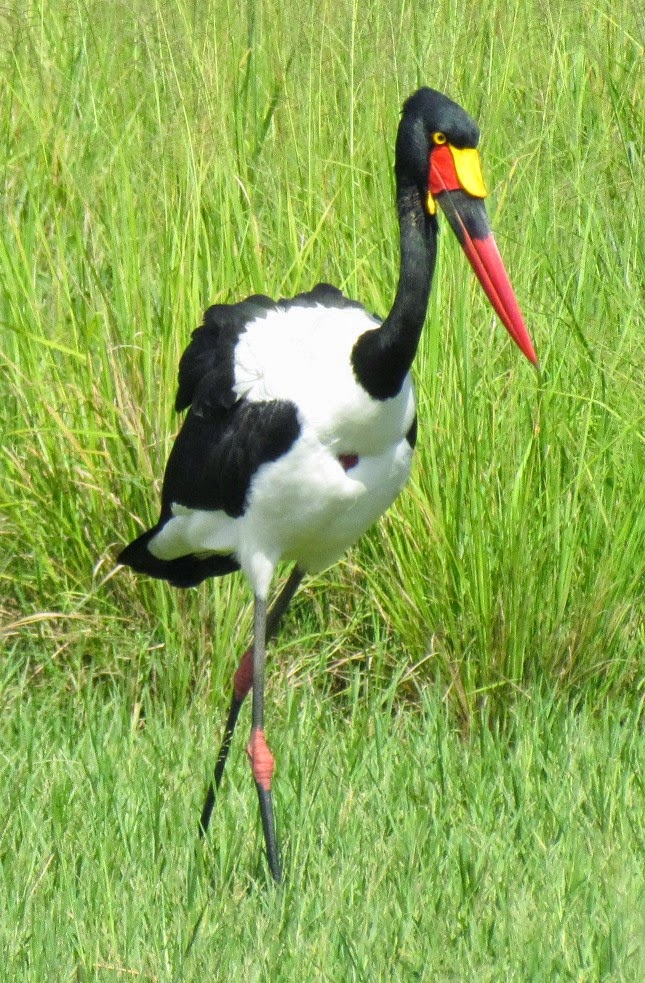
Was delighted to spot the Saddle-billed Stork strolling the reeds at Murchisons Falls - Uganda's largest National Park.


 Two Senegal Thick-knees at MF.


 The majestic pelage of the Guereza (Abyssinian) Black-and-White Colobus. What a luscious tail.


 Uganda's national bird - the Grey-crowned Crane.


  • At the top of Murchison Falls, the Victoria Nile forces its way through a gap in the rocks only 7 m wide, and tumbles 43 m down. It then flows westward into Lake Albert. The outlet of Lake Victoria sends around 300 cubic meters per second (11,000 ft³/s) of water over the falls, squeezed into a gorge 7 m wide, making it the most powerful waterfall in the world in terms of sheer water pressure (pressurised ejection of water with the highest force ever). The spray, as you can imagine, is fabulous.


  • The Jackson's Hartebeest (Alcelaphus buselaphus) is unmistakable with its narrow face. We only got this ungulate here in Murchisons Falls. We learnt quite a bit about the biogeography of animals - MF has giraffes but no zebras. Lake Mburo has zebras but no giraffes. We missed the lions at MF- giving us just two more chances of getting the king of beasts - in Queen Elizabeth NP and Lake Mburo - very dicey if you ask me. Imagine going to Africa and not seeing the lion, we'll be laughing stocks. We had to persuade Gerard to let off the pursuit of birds to look for the lion, luckily he didn't need much convincing. We also missed the leopard - only Crammy and the site guide saw something slinking down the tree - some of us saw it too, but not well enough to say we saw spots. Tim saw the grass move. I also had the impression that the hyena was a given. Not so, we only got a brief glimpse of it through tall grass at the Ishasha sector before it trotted off and disappeared. The confusing thing was that Crammy and others saw the Hyena lift its tail like a warthog - making him think it was a warthog we saw. Later on, I found out that hyenas walk with upright tails too when they are agitated or excited. So animals were not easy to come by, quite unlike what we see in documentaries. We learnt to be thankful for everything we got.


 African White-backed Vulture (Gyps africanus) at MF. Again, vultures were less common than we thought. Sadly, we didn't even see the Secretary Bird, something of a classic in my mind.


 Another myth dispelled, at least for Tim. He never knew that Giraffes congregated in huge herds. The biggest we saw had 23 Rothschild's Giraffes together. It was so moving to see them bounce across the plains, wild and free. According to Wikipedia, males establish social hierarchies through "necking", which are combat bouts where the neck is used as a weapon. Uganda does not have two other giraffe subspecies that are found in Kenya - Reticulated and Masai. In all, there are nine subspecies of giraffe in Africa.


Crammy's van had a pop-up roof converting it into a convenient safari vehicle anytime. Here, we had a very fulfilling game drive through lush Borassus grassland - seeing African Buffalo, African Savannah Elephant, Yellow-billed and Red-billed Oxpecker, Defassa Waterbuck, Uganda Cob, Patas Monkey and more.


 It was a magical moment when we came across the nest holes of the Red-throated Bee-eater (Merops bulocki) in the MF launch cruise safari. In most of the national parks, we always had a drive-through safari in the morning and a cruise safari in the afternoons.


A gargantuan Nile Crocodile seen during the ferry cruise at MF.

Striped Leaf-folding Frog (Afrixalus quadrivittatus) found just outside our banda when I went out to pee in the wee hours of the morning. An advantage I would say of not having ensuite bathrooms. This was the second leaf-folding frog in the trip, the first was in a small pond on the drive back from MF waterfall.

 Crammy found our very first snake - Spotted Blind Snake (Typhlops punctatus) - right across the road on the drive to Kibale NP near nightfall. It was half-dead sadly, possibly run over by several vehicles. Tim picked it up and left it at a roadside ditch.


 One of our most luxurious accommodation was at Kibale Forest Camp - a very nice-smelling spacious tent with soft beds and spotless rooms. First time that we had to zip the 'door' shut - there were no locks. The only thing I didn't like was the eco-toilet - using soil to cover up. It had a bit of a smell. Tim didn't even use it - he rather preferred to make the trek to the reception to use the real toilets. We also got used to having to charge our electronic devices at the reception - practically all the national parks' accommodation ran on generators that were not powerful enough to have in-room chargers. 

The best part of Kibale Forest Camp was the wildlife that were all around us - we got the African Wood-owl (Strix woodfordii) just outside our tent - Tim found it. Also had Thomas' Dwarf Galago (Galagoides thomasi) calling raucously outside our room - we got a blurred photo of it when it appeared in the same tree as the owl. Very exciting to have bushbabies frolicking in the trees outside. We paid US$30 to see the other bushbaby - Eastern Needle-clawed Bushbaby (Galago matschiei) in Kibale Forest. This one had a strange ascending call that was unforgettable, and moved lightening fast - I was more used to the sedate pace of the Slow Loris - the bushbaby was like a super-fast squirrel, bounding from tree to tree, only quick looks were its very bright orangey eyes. Another nightwalk hopeful that was rare (and we missed) was the Potto - the guide has only seen it twice in eight years. Apparently Kibale Forest is up to 1,590 m asl, with 325 bird species including six Albertine rift endemics - Mountain Masked Apalis (Apalis personata), Blue-headed Sunbird (Nectarinia alinae), Collared Apalis (Apalis ruwenzorii), Dusky Crimsonwing, Purple-breasted Sunbird and Red-faced Woodland-warbler (Phylloscopus laetus). We missed the Crimsonwing and Purple-breasted Sunbird. Funny enough, we got the other four endemics in Ruwenzori.

The male alpha Chimpanzee in the group that we tracked that morning in Kibale Forest. It was the only chimp found on the ground. The rest of its troop was high up in the trees. We could hear the loud calls of the chimps - they were beating the trunks and hooting away as we approached them. I even saw two of them copulate, for just a brief few seconds. The female was in oestrous - its bum was swollen (which could be seen through the bins). Tim accidentally strayed into the 'territory' of the alpha, and was scared off by his loud response and slight lurch. Kibale hosts 13 species of primates including the chimps. It has up to 1,450 chimps - representing Uganda's largest population. Other primates we saw included the Red-tail Guenon, Blue Monkey, Grey-cheeked Mangabey and

Red Colobus. Tim lost his spectacles in the forest, but luckily our guard and guide found it back.

Sadly, the next morning, we were late and missed the display of the Green-breasted Pitta. We caught many glimpses of the bird, but only very shadowy looks - not counted. 


After the morning's chimp tracking, we came back for lunch - that was when I found the Forest Night Adder (Causus lichtensteiniislithering along the pathway near our rooms. It was unhurried and had a blue forked tongue. Blue triangular head on olive body - venomous. Our second and last snake. Videod it. Was frantic in trying to get Tim to come take a look, but he didn't hear me calling out to him. Only Gerard, who happened to be passing by, got good looks. Luckily, I managed to find it again for Tim a few minutes later. But Tim only caught a glimpse as it dove straight for the bushes.


 We had a pretty frustrating morning at Semuliki's Kirumia Trail. The muddiest trail we had ever birded in - the boots were essential - all of us brought our own boots for the trip. Poh Bee was very proud of her pink Crocs. The birds were all at the canopy level of very tall trees including the Piping Hornbill and the Red-billed Dwarf Hornbill. We came to Semuliki for a stab at Guinean-Congo (Central Africa) birding, not found elsewhere in East Africa - but only managed one such endemic - Red-rumped Tinkerbird (Pogoniulus atroflavus). One good thing - we got to see the original habitat of the Oil Palm and got the Orange-cheeked Waxbill (Estrilda melpoda), a bird that is not yet on the Ugandan bird list but is known to regularly occur on the roadsides of Semuliki. Here, we made a pit stop at Semuliki Hot Springs, a bubbling sulphurous area hot enough to boil some eggs in (yes, we had hard-boiled eggs). Very pretty limestone deposits that came is shades of pink, green and of course white.


 The Dung Beetle! Was very excited to see the classic sight of the Dung Beetle rolling his piece of 'dung' - earth backwards, in the evening at MF. We saw this beetle one more time, the second sighting produced a teeny weeny thingy rolling his dung.


 The friendly kids at a roadside church in Semuliki. The little girl in front even somersaulted.
 Breakfast with a view at the Mountains of the Moon Hotel - 1.5 hours away from Semuliki. We had opted to stay here when Gerard read poor reviews of Vanilla Hotel.


 The BEST moment of my trip was finally seeing the Ruwenzori three-horned Chameleon. This is the female - it is sloughing. I love its slow deliberate movements, the way its extremities are opposable.


Poh Bee was equally delighted and even placed the chemy on her arms and hat! It is a myth that chameleons change colours easily - they only change hues according to their moods.  We got both chameleons (male and female) within the first hour of our 3D2N Ruwenzori Climb.

Ruwenzori three-horned Chameleon - male. So colourful, so amazing, so invisible. Throughout the rest of the trip, the chameleons evaded us, even though I looked in every bush.

 The view got better as we ascended the Ruwenzoris. We started the hike at around 1,500m.


 Our first picnic lunch - the porters arrived way ahead of us - trekking at a clipped pace (we plodded slowly behind). We had what Gerard claimed - the best field-cooked sphaghetti of the trip. He kept raving about it, and praised the chef to no end. We also had the first of many super sweet pineapples and even a chequered picnic mat set up under a shady tent. Talk about pampered. Eighteen people (including Crammy) served just the four of us - we had to give out as much in tips. They were porters, cooks, guides and guards with AK47 rifles. The only danger was Forest Elephants (unfortunately, we had to walk in their muddy prints, otherwise, no other signs of them).


 Gerard's bird-of-the-day - the endemic Ruwenzori Turaco. Crammy is incredible at spotting and identifying birds. We really owe all our sightings to him. On Day One of Ruwenzori, we climbed through pristine rainforest of the Kyambogho Ridge with a view of the Mubuku Valley. After the forested ridge, we arrived at the Omu'ka Kizza Rest Camp at 2,977 m with supposed views of Ruwenzori foothills and Kasese town 2,160 m below.


 Finally, on Day 2, we descended into the 'Valley of the Single Lobelia' - Gerard's fond name for it. It was a beautiful verdant mossy valley with just ONE Giant Lobelia. Sadly, and most disappointingly, we were too low down to see the other botanical giants that the Ruwenzoris are famous for - the Giant Groundsel and Giant Heather. On Day 2, the forest gave way to thick bamboo at 2,700 m. We reached 3,515 m at some point after the Giant Lobelia. We then crossed over to Lake Mahoma Camp at 3,134 m where we shuddered through the night. 


 Camping was a cold affair. The first night, I couldn't get to sleep at all. I did everything to warm up, but to no avail - I just could not get warm. From 4 layers, I put on layers 5 and 6 (Tim's big sweater). Used my tuk, gloves, silk sleeping bag, reflective aluminium mat and even slept in the foetal position. All to no avail. The temperature was around 5 to 10 degrees celsius. The tent was to blame too - it was very nice and roomy - a six-men tent that we could stand up in. But it had open mesh on 3 sides - meant more for summer camping. It rained the first night and tiny sprays could be seen in the tent. Water also gathered at the sides. The second night was better as both Poh Bee and Gerard rescued me with their chemical warmers. At least I slept a little. 


Trekking was a very muddy affair. Again our wellies were essential. We also water-proofed everything - wearing rain-proof pants, rain gear, rain hat, rain cover for our backpacks etc etc. Spent SGD$1000 on equipment alone for this trip. Our guides carried our boots which we put on whenever the mud eased off. We needed the stick to navigate down very slippery slopes. Day 3 was the worse as it rained most of the day. Poh Bee's guide was there to help push and pull her along. I carried my own day pack up, but it was really tiring. Still, it appeared that everybody enjoyed the Ruwenzori leg. Gerard even said it was one of his trip highlights as it reminded him of being a little boy camping again. To me, seeing the chameleons alone made it worth the while.

Saturday, 13 February 2010

Canada West Coast Adventure - Part 2

By Gloria Seow

Trip Participants: Tim and I

Flying out from Toronto, we landed in Vancouver to begin the second leg of our trip, this time planned by moi. To me, Vancouver integrates well its natural beauty with its infrastructure. I rather liked the waterfront view from Canada Place.


On our jaunt through Gastown to see its famous steam clock, we dropped into this souvnir haunt, and bought several hundred dollars worth of rubbish for our family and friends including maple candy. Later on, we discovered that Michelle was the start of the souvenir (omiyage) shop row, and that it had one of the most expensive buys! Darn. They were already selling memorabilia for the Vancouver 2010 Winter Olympics which would only take place four months later from 12-28 Feb 2010.


I innocently booked a hotel via the internet called Budget Inn Patricia on East Hastings Street, as I thought it offered good value for money. We found out to our chagrin, only while there, that East Hastings is on the wrong side of town, being a notorious drug dealing district next to Chinatown. Tim's friend was horrified that we were staying there. Our hotel room itself was small but fairly comfortable. We had to endure its dangers though – homeless and gangster-like characters prowling the streets outside. The homeless can be easily identified as they usually pushed a huge shopping cart with all their belongings tossed inside. Tim heard from his cab driver on his way to UBC (University of British Columbia ) where he caught up with some ex-colleagues, that another taxi driver had his throat silt the night before, at East Hastings. Luckily Tim only told me about this incident post-trip, if not I would have freaked out. While coming back after dinner on those nights, when the skies had already assumed a dark demeanour, I carried my heavy Fenix torch as a potential weapon should we be attacked. The worst scene was Tim running up and down the scary street trying to buy 4 litres of drinking water, and not succeeding as most shops were understandably closed or only sold the 2 litre bottles. I wanted to tell him "Forget it!" (I was made to wait in the lobby), but did not dare to step outside alone.

A juvenile Glaucous-winged Gull perched just above the railway tracks near Canada Place. It was calling for a mummy who never showed, at least not while we were around.

Sea planes are common in this part of the world, the fastest means to reach remote places. I wanted to take one of these to Tofino direct, as it would have saved us a full day of travelling, but too bad they stopped this service during autumn/winter. Obviously, only the summer months and its attendant crowds can support its operations then. They had services to Victoria though, but we had no business to be there.

The expansive sea at Canada Place. A very scenic part of Vancouver City.

The whale-watching town of Tofino (on Vancouver Island ) was next. We missed our Greyhound due to a misplaced fax which resulted in a half-day lost of time. The trip took 7 hours (everything in Canada is a half-day or full day’s travel away, very annoying), and I enjoyed the hour-plus ferry ride to Nanaimo where I braved strong winds to do some pelagic birding with lifers like Leach’s Storm Petrel and Common Murre. Even in Nanaimo where we had some time before our onward bus to Tofino, I managed to get lifers (ie. street birds) like the Spotted Towhee, California Quail and Brewer’s Black Bird. Memorably, at the Nanaimo waterfront, we saw our first Harbour Seal and I spotted a scampering Mink that had a beautiful rufous coat.


The view from Lions Gate Bridge as our coach (Tofino Bus/Greyhound) drove north towards Horseshoe Bay Ferry Terminal where we caught the Nanaimo ferry. Early that morning, we arrived JIT at the bus terminal, but that was not enough. It was my fault, I had not read the ticket stub which stated that we were supposed to be there 20 minutes before departure. And so we missed the bus. More importantly, Greyhound did not have any records of us coming onboard as I had booked via the internet through Tofino Bus. This necessitated the buying of another set of tickets for the 1030am bus. We called Tofino Bus and raised a ruckus. In the end, we found out that their 'automatic fax system' to Greyhound to book our first leg of the journey had malfunctioned. I was relieved that they reversed the charges on my credit card. We also paid less buying on the spot rather than buying online. And we managed to change to a late departure from Tofino, making up for the lost 4 hours of waiting.

Tim shooting gulls and cormorants from the Nanaimo ferry, a metallic hulk of a ship that cut across the Strait of Georgia at a steady clip. Our bus was parked on the lowest deck, and we were allowed to wander around. Food and beverages can be bought in an onboard coffeeshop.

We had lunch at this restaurant in Nanaimo. Suagu me bought my first handful of gumballs from the dispenser for a quarter.

In Tofino, we stayed at Weigh West Marine Resort, a nice marina fronted hotel with its own whale-watching trips. We were fortunate to be captained by Pipot a French guy who has been in Tofino for 20 years, and one of the best whale spotters around. The 2-hour whale-watching expedition threw up pods of spouting Grey Whales barely 5m from our Zodiac, and some Humpback Whales – one of them breached (ie. jumped out of the water offering jaw-dropping views of its head and arching body followed by a classic tail flick – most exciting as it was only 15m from us). We also saw colonies of Stellar Sea Lion and Harbour Seals basking on rocky outcrops, a sight straight out of National Geographic documentaries. In and around Tofino, we enjoyed a short sojourn through one of the last remaining temperate rainforests left in the world at Meares Island where giant Cedar, Spruce and Hemlock trees up to 6m across, and approximately 1,500 years old grow unmolested, with some of these trees rivaling the biggest in our tropical rainforests. Tim informed me that this wooded grove was saved from loggers in the 1980s (he was part of the environmental movement then), and such temperate rainforests once cloaked the European continent but are now no more. Sadly, the trees on Vancouver Island itself (and over most of Canada) are heavily logged – but with more sense than in the tropics – in Algonquin, we were told that a third to half are logged in each forest patch so that the smaller trees left standing can at least hold the soils together, thus preventing tragic landslides.


At Weigh West Resort where we stayed, we came across a family of three racoons. They emerged at dusk to forage at the rubbish dump, and ducked under the kitchen's floorboards when done feasting. This was our second racoon sighting after Cootes Paradise. We saw them again the next night in the same manner. Racoons are the Rattus norvegicus (Brown Rat) of Canada. Tim said that they were common around his university and were even able to chew through locked steel dustbins to get at food.


Blackberries growing wild by the roadside in Tofino. Of course we couldn't resist popping ripe ones into our mouths, especially when the same thing sold in Singapore by the punnet costs around SGD$5.


On our first birding day in Tofino, we went to a known birdwatching spot. Quite disappointingly, we did not get anything special at these mudflats except close views of a flock of Canada Goose. Guess the tides were not in our favour.


The seaweed strewn mudflats. Isolated and peaceful, with no other humans encountered for several hours.


To amuse ourselves, we got macro and found much marine life, although biodiversity was low. There were quite a number of these scuttling marine crabs, about 3-5cm across at the widest point in its carapace.


I found the smashed-up shell of a living bivalve, which I suspect is the work of the Black Oystercatcher. I read that these birds employ two contrasting techniques for opening 'oysters' - either smashing them with their strong beaks or on rocks, or prying them open. As a result, they either had sharp or blunt bills. Or it could be the work of Sea Otters or even humans.


Another amusement for us was to take photos of the calm waters and distant snow-capped mountains.

A purplish-pink halo of an orangey sunset at MacKenzie Beach in Tofino. My first time seeing this mini-rainbow of a sundown. At MacKenzie, there were plenty of beachfront hotels and locals hanging out on the wide sandy stretch fronting the Pacific Ocean. We also photographed a Common Loon fishing here. Bicycles were our main mode of transport. Rental for them is exorbitant - C$35 if I remember correctly for a full day use per person. On hindsight, we should have just rented a car.


The serene afterglow of the setting sun.


And finally, a deep purple finale, inducing in one a wistful, reflective mood.


We were all bunched up in wind-proof suits for our two-hour whale watching expedition. As it was the low season (although we were in Tofino during the Canadian Thanksgiving weekend of 12 October 2009), we paid a cheap rate of C$69 per pax for a Zodiac ride (ie. a bouncy roller-coaster of an inflatable). Rates can go as high as C$99 for a stable family boat. Pipot told us that because of El Nino, the whales were still lingering on in the plankton rich waters instead of migrating.


There she blows! A spouting Grey Whale at very close proximity. We had at least 5 of these biggies surrounding us. At times, they came as near as 3m. Truly awesome!


A colony of Stellar Sea Lions grunting away, basking, sliding around, pushing each other and frolicking on the rocky outcrops off Tofino.


Two Harbour Seals, probably juveniles, on another rocky outcrop. We got much better views of adults in Nanaimo and at Port Alberni.


The distinctive head of the Humpback Whale. I didn't bother to take good shots as I'd rather be gawking at the real thing in front of my eyes than squinting at the tiny image in my digital cam. Pipot brought us to another patch of sea, away from the Grey Whales, to look for the Humpbacks (which are much bigger than the Grey). Tim said that I was lucky to see both whales in the same trip. He took 10 years to see both. Pipot also taught us how to spot spouting whales. At least some of us managed to find some of our own Grey Whales (after all they moved in a pod).


The final act of the breaching Humpback - the famous tail flick before it plunges into the depths. I felt privileged and was really thrilled to witness the whole sequence.


At Meares Island in Clayoquot Sound, part of the Pacific Rim National Park, we revelled in the old growth temperate rainforest with giant trees that are around 1,500 years old. We took the 2km Big Tree Trail, a boardwalk that cuts through the mossy forest (very soft to walk on, as if carpeted) and ended at a tiny beach before looping back.


The gnarled, many-armed appearance of this Cedar reminded me of Lord of the Rings and Frodo riding on the Giant tree. Meares Island has the world's largest Western Red Cedar and Hemlock trees with trunk diameters some 6m across.


Banana Slug (Ariolimax columbianus) is a huge slug around 10cm long. It apparently feeds on cedar wood fibres and leaves a gooey trail as it slides along the forest floor. We also saw a squished slug - apparently people stepping on one experience the same effects as treading on a banana, hence its name. Wesley informed us that this slug can also be found in his garden.


The forked bulbous seaweed that clothed the rocks on which our simple wooden jetty stood. Meares Island.


Our water taxi owner-cum-driver pointed out the Orange Seastars just opposite the jetty. The 10-minute water taxi cruise to Meares Island from Tofino cost a hefty C$30 per pax for the return journey. On our ride there, we met a couple who worked in the upmarket Wickaninnish Inn. The guy was from India and I was a little surprised to find out that foreign labour is employed even in this remote part of Canada. The couple were dropped off at the tough Lone Cone Trail which involves scaling a mountain for perfect vistas of the area. On our return ride, our driver came in a smaller boat to fetch us. His wife is the coordinator, taking calls and dispatching him to pick up passengers all over Clayoquot Sound.

The Tofino Bus brought us to our next stop at Port Alberni . The main reason for us coming inland was to take the day cruise on the MV Frances Barkley (a passenger and cargo vessel) up the Alberni Inlet which promised the chance of bumping into wildlife like the Black Bear, Orca, dolphins, porpoises, sealions etc. Quite disappointingly, the cruise was a rather boring (some would call it relaxing) journey characterized by groups of frolicking California Sea Lions and lots of gulls (Western, California & Herring) breaking the monotony. There were no Black Bears or Orcas, and I felt that we had somehow wasted the day. However, we did experience the area’s slow pace of life as the MV Frances Barkley delivered mail and cargo to the inlet’s isolated communities (the main industries here are logging and fishing). The next day, we met up with local birder Wesley Bricks who kindly took us out birding. To beat the constant drizzle that plagued our trip, Wesley arranged for us to have coffee at another birder’s (Shirley) home where we could watch birds coming to feast at Shirley’s lovely sunflower-filled garden (which she called her "birdfeeder"). At least we had lifers like the Varied Thrush, House Finch and American Gold Finch while out with Wesley. On the cruise, somebody told us that he saw at least four to five Black Bears at the Robertson Creek Hatchery as they gathered in numbers to gorge on the yearly salmon run. Our host Wolf also said that bears can be readily seen at Stamp Falls. Everybody made bear sightings sound so easy. Wesley obligingly drove us over to the hatchery. To our great disappointment, no bears materialised, but I spotted a Black-tailed Deer (lifer) from the car. We were beginning to despair of ever seeing a bear as we headed back to town for some lunch. Lo and behold, on the opposite bank of the Somass River where we had parked for chow at the Clam Bucket, Tim spotted a Black Bear! At the very last instance, God delivered the package and I was most thankful.

White-crowned Sparrow (Zonotrichia leucophrys) found on a roadside bush.


We opted to cook a pasta dish from ingredients found in Wolf's House, also known as the Tsunami Backpackers in Port Alberni where we stayed for two nights. The greenish-red Russian tomatoes, zucchini and spicy green chilli were fresh from his garden. Tim was reluctant to cook at first, preferring to walk almost 2km to town for dinner. I refused to budge from the house as I could not bear to face the cold stroll. In the end, he buckled and stole the kitchen from moi. Turned out that he voted this meal his best!


The next morning, we ate a hearty breakfast of mash, ham, toast and eggs with hot sauce before embarking on our day-long Alberni Inlet cruise. This greasy breakfast was at a restaurant just by the pier and is typical of huge Canadian portions. The comparitively tiny burger (in front) was enough for me, downed with hot coffee.

Logs being floated downriver was a common sight all along the otherwise peaceful inlet. Quite a heart-breaking scene, but if they were logging just 1/2 to 1/3 of the standing trees, as per the situation in Algonquin, then it is still better than the case in SEAsia where entire tracts of lowland primary or secondary forest morph from green to brown at the drop of a hat, to create more and more oil palm plantations for the food and biodiesel industries.


The Captain of the MV Barkley Sound was kind enough to entertain us. He showed us how navigation up the inlet was entirely via computerised GPS. The captain's wheel is hardly used anymore. From his elevated perch, he also helped look out for any wildlife, but throughout the journey, there were none special enough to stop the boat for.

Gulls mobbing a California Sea Lion which had caught a fish (possibly salmon). On the return leg, we witnessed lots of these noisy birds hovering above the little pods of sealions, hoping to snatch a free meal.


Tim was persistent in photographing the monotonous wildlife that churned around us, enduring the howl of the chilly winds. We took turns alternately wielding the camera or warming up indoors. The whole boat was excited when the first sealion was spotted, but soon grew bored when it was more of the same throughout our 8-hour cruise. Here, a pair of California Sea Lions came relatively close. Often, visitors mistake these for dophins, especially when seen from afar.


At the tiny town of Bamfield, we were given 45 minutes to stretch our legs onshore. Here, I found out that there are six species of Pacific salmon that inhabit these waters (Sockeye is missing from the list). Most salmon return to their natal rivers to spawn when they are around 3 to 5 years old. Jacks are an uncommon group of yearling Chinook that mature rapidly and can spawn when they are just one year old. As such, Jacks are half the size of full adults. As the anadromous salmon swim upstream, they stop feeding and their flesh turn from a fatty orange to a mushy white (regarded unsuitable for human consumption). Outwardly, they change from silver to red to black. All Pacific salmon die soon after spawning.


Autumn in this part of Canada is devoid of red, as the Southwest corner of British Columbia is dominated by Bigleaf (Broadleaf) Maple, which turns yellow and then brown when winter approaches. Its leaves are huge, ranging from 15 to 30 cm across, bigger than our faces! The region's temperate rainforest biome (rainfall exceeding 250cm/year) is rare in the world, making up just 0.02% of the earth's terrestial surface. The other half of this forest comprise evergreen conifers such as Western Hemlock, Western Red Cedar, Douglas Fir, Amabilis Fir, Yellow Cedar, Sitka Spruce and Red Alder.


Dungeness Crab (Metacarcinus magister). Magister means master crab. It is an edible crustacean that is common in the West Coast, from Alaska to California. We drew a blank when we enquired on a diner that served it. We tried the Clam Bucket, but sorry, no crab for dinner. Photographed this at a fresh seafood store.


Back on Vancouver Island, the streets were lined with planted Red Maple, and Tim here has a strip of smoked salmon that he devoured with glee.


At the Clam Bucket restaurant, we ordered Maple Salmon and a bucket of Clams & Mussels. My salmon slab was marinated in maple syrup. Instead of tasting strange, it was actually succulent and not overly sweet. In comparison, the bucket of bivalves was too well buttered.

Wolf and I in his kitchen, just before I dashed off for the day. Wolf is a very interesting character - he worked in Palawan (The Philippines) for 13 years as a dive instructor and has held outdoor jobs all over Asia. He is able to count in Cantonese (at least from 1 to 10), and walks around in shorts and bare top when I was shivering under three layers of clothing. He also offers canoeing at the Somass River (just outside his house).


Shirley, Wesley Bricks and us in Shirley's cat kingdom - notice the big kitty that Tim is stroking. Shirley had four of these cats. We contacted Wesley through Birding Pal, and he said that we were the first overseas birders who had ever got in touch this way! Shirley's garden yielded two lifers for us - the American Goldfinch and House Finch.


Spotted Towhee pecking on sunflower seeds growing in Shirley's backyard.

Wesley then drove us to the Robertson Creek Hatchery which specializes in breeding and rearing Chinook and Coho salmon, as well as Steelhead Trout (another saltwater salmon species). The Rainbow Trout is the freshwater cousin of the Steelhead that never migrates to the sea. After some seven months of fertilization/incubation, the smolts (tiny fishes) are released down the Somass River for their return journey to the sea where they grow to full adult size. The hatchery produces 8 million chinook smolts, 1 million coho smolts and 180,000 steelhead smolts each year. Only a tiny percentage make it to adulthood: an estimate of 150,000 Chinook, 100,000 Coho and 10,000 Steelhead adults are produced each year for the fisheries in the region. We watched in certain horror as the workers thrashed the blacken salmon with their baseball bats, milked them for their milt/eggs, and left them to die in a bloody tank.

Coho salmon that had already turned from a silvery to a black exterior. At this point, its meat is deemed unpalatable to humans, described as white and mushy, and fit only for the pet food and fertilizer markets.

Salmons thrashing around in the long sink as they were being sorted and clubbed together with other similar-sized breathen.


The aftermath of the clubbing session. Really disgusting to see fish still attempting to swim in their own blood.

Wesley's cosy loghouse which he designed and hand-built himself over a period of five years, working on it every weekend. Utterly impressive! We especially adored his open air sun-lit attic which he uses as an art studio for hobby painting. Tomatoes and other plants drape the staircases. He maintains a thick grove of trees around his property. As such, being in the attic was like being amongst the birds at the tree top level. His house is so admired that he has become a part-time architect and builder, with friends asking him to design-and-build their homes too. He is a retired science teacher.


Orange and red maples planted in a neat row at Port Alberni.


The Somass River runs along River Road where we stayed. The Clam Bucket (restaurant) is on the town end of River Road. We finally saw our Black Bear on the opposite bank of this river while parked just outside the restaurant. Wolf told us that a female bear walks through his garden every night after midnight (he finds evidence of her visit in the morning) - I was intrigued yet spooked by this knowledge. As a precaution, I shone my torch at every shadow in his garden when we returned back at dusk (we had to walk through part of the garden as the door was around at the back), intent on exposing any hidden bear, and praying that there would be none, not at such close range anyway. Wolf also said that he regularly sees bears on the opposite bank of the river too, especially at low tide.


Finally, the sight of a foraging Black Bear at the last possible instance saved the day and made us all very happy.


Wesley said that this bear is likely a to be a juvenile male.

On our last full day in Vancouver , we spent the morning birding Stanley Park , a mixed forested / manicured park that offered views of the Vancouver waterfront, garnering only two lifers: Red-breasted Sapsucker and American Coot. I toured the Vancouver Aquarium alone while Tim made his way to the University of British Columbia to lunch with his ex-colleagues. The Aquarium held many fascinating marine / amphibian life: Beluga, Pacific White-sided Dolphin, Sea Otter, swimming (not burrowing) Caecilians, Poison Arrow frogs, the neotenic mole salamander Axolotl etc. We then rendezvous at Granville Island where we saturated our senses with the array of fresh produce, hams, and seafood on sale at its Public Market, and succumbed to nibbling quiche, wild rice salads, blueberry pie and an assortment of delectable delights at its food court.
Double-crested Cormorants, sunning themselves at Stanley Park in Vancouver City.


The curious looking Axolotl, a neotenic mole salamander. I love its pink external gills and its albinistic bare skin. Saw this at the Vancouver Aquarium.


Juvnile beluga with gull. I was pleased to see white belugas swimming around in a relatively big pool.


My favourite animal at the Vancouver Aquarium - the charming Sea Otter. This fella was feasting on shelled shellfish, using his belly as a 'table', as its wild counterparts do. The Sea Otter is famous for its ability to use rocks to dislodge and open shells, making it one of the few mammals to use tools. It is the heaviest member of the weasel family but one of the smallest marine mammals around. It keeps warm by having the densest coat of fur in the animal kingdom.
All in all, Canada, as the world's second largest country with a relative tiny population of 33.8 million, was a good introduction to birding North Amerca. It offered plenty of wildlife spotting opportunities and pretty landforms, leaving us with tonnes of indelible memories.

Canada Bird List 27 Sep to 18 Oct 2009 (East & West Coast)
By Gloria Seow

Places Birded
1. Algonquin Provincial Park APP - 300km approximately north of Toronto.
2. Toronto environs + High Park THP - around Toronto
3. Long Point LP - 200km approximately southeast of Toronto,
4. Hamilton / Cootes Paradise + Dundas Valley HCP - 75km approximately west of Toronto
5. Vancouver Island VI - covering Tofino, Nanaimo & Port Alberni
6. Vancouver Stanley Park VSP - this is the city's green lungs, 1/2 hr ride from downtown Vancouver.

Sequence below follows:
Number, Name, Scientific Name, Location & Remarks

1
Canada Goose L1
Branta canadensis 76-109cm
THP, LP, HCP, VI
First saw it in a huge flock grazing on trimmed grass like cows, while driving to Algonquin. Common in flocks all over rural Canada. Had excellent views of them at one of Long Point's secluded coves.
2
Tundra Swan L2
Cygnus columbianus 132cm
HCP
Saw 2 swans flying in the distance at Cootes Paradise. Similar to Bewick's Swan I've seen in Japan, now this race has been spilt into a full species.
3
Wood Duck L3
Aix sponsa 47cm
THP
In High Park - saw only 3 females huddled together in the pond. Blue Jays were flying and nosiy all above us.
4
Mallard
Anas platyrhynchos 58cm
APP, VSP
Swimming in small flocks, mixed with American Black Duck in APP. Saw a hybrid American Black Duck x Mallard with deep blue speculum. Huddled in a row on a log in Stanley Park.
5
American Black Duck L4
Anas rubripes 58cm
APP
Calmly swimming amongst canoeist at Rock Lake inAPP. Violet speculum bordered in black shows very well and is visually stunning.
6
Canvasback L5
Aythya valisineria 53cm
VI
Fly-by views.
7
White-winged Scoter L6
Melanitta fusca 53cm
VI
Saw it on the ferry to Nanaimo.
8
Common Merganser
Mergus merganser 64cm
VI
Swimming in small groups of 3-5 birds at Somass River.
9
Red-breasted Merganser
Mergus serrator 58cm
VI
Swimming in small groups of 3-5 birds at Somass River.
10
California Quail L7
Callipepla californica 25cm
VI
Unbelivably, saw two female quails foraging by the roadside while passing by in the bus, from Nanaimo towards Tofino. They ran into the bush when the bus came closer. National Geographic field guide said they are common, even in the suburbs.
11
Pacific Loon L8
Gavia pacifica 66cm
VI
While out whale watching in Tofino, we saw scattered individuals floating out in the sea, near the whales.
12
Common Loon L9
Gavia immer 81cm
APP, VI
First flushed an adult still in breeding plumage in APP, near our Eco-Lodge. Saw one fishing at MacKenzie Beach in Tofino - Tim photographed it.
13
Leach's Storm-Petrel L10
Oceanodroma leucorhoa 20cm
VI
Ferry to Nanaimo. Fly-by views
14
Double-crested Cormorant L11
Phalacrocorax auritus 81cm
LP, VSP, VI
Common along the coasts. Good views in Stanley Park.
15
Green Heron L12
Butorides virescens 46cm
LP
Only saw one juvenile perching in pond next to Cemetery, spotted by Tim.
16
Great Blue Heron L13
Ardea herodias 117cm
APP, HCP, VI
First spotted it while canoeing in Algonquin. Biggest bird around. Fairly common along coasts in VI, same niche as Grey Heron.
17
Turkey Vulture L14
Cathartes aura 69cm
LP
Some volunteers at the bird ringing station in Long Point (Old Cut Road) pointed out my first Turkey Vulture. Later in the day, just outside our motel, we counted 30 of these raptors swirling just above. Quite spectacular. Fairly common aruond LP. Turkey Vultures are the only vultures in the world that uses smell to locate carrion. All others use sight. As a result, they are always first to arrive. Being the smallest of the lot, that is advantageous. New World vultures are more closely related to storks than to true raptors.
18
Northern Harrier
Circus cyaneus 41-51cm
Vancouver airport
Quatering flight next to my plane just before take off.
19
Bald Eagle L15
Haliaeetus leucocephalus 79-94cm
LP, VI
Truly majestic creature. Love its massive bill. First saw it at LP catching a duck or fish? Then many good views at VI, at jetty when we went whale watching. Fills the niche of Singapore's White-bellied Fish Eagle. As common too.
20
Sharp-shinned Hawk L16
Accipiter striatus 25-36cm
VI
Saw it perched on a tree in a garden at Wolf's house, Tsunami Backpacker, where we stayed in.
21
Red-tailed Hawk L17
Buteo jamaicensis 56cm
LP, HCP
First saw it while driving home from Long Point, on a roadside tree. Managed to stop the car and binocular it as it took flight. Red tail very prominent and easy to ID. Saw it again with Susan in Webster's Fall.
22
American Coot L18
Fulica americana 39cm
VSP
Views from 2m away at Stanley Park. Both juv and adults.
23
Black Oystercatcher L19
Haematopus bachmani 45cm
VI
Saw 3 birds flying by in Tofino, while we were standing on the main jetty. Plenty of ducks flew by too with acceptable views, but were impossible to ID coz unfortunately, they largely look the same to me, versus the distinctive plumage of the oystercatcher. Also, I'm not familiar with Canadian ducks.
24
Solitary Sandpiper L20
Tringa solitaria 22cm
HCP
Tim spotted it standing in a river that flowed below the main road in and out of Dundas. Supposed to be fairly common in Canada.
25
Ring-billed Gull L21
Larus delawarensis 45cm
All Coasts
Most abundant gull encountered, everywhere near the sea. Tame and approachable. The one in Niagara Falls was 20cm from me.
26
California Gull L22
Larus californicus 53cm
VI
Saw it on the cruise in the Alberni Inlet on the MV Frances Barkley.
27
Herring Gull
Larus argentatus 64cm
Vancouver City
Fairly common on the coast in Vancouver. Sightings in Stanley Park, Granville Island, Canada Place.
28
Western Gull L23
Larus occidentalis 64cm
VI
Saw it on the cruise in the Alberni Inlet on the MV Frances Barkley.
29
Glaucous-winged Gull
Larus glaucescens 66cm
VI
Cruise to Nanaimo.
30
Common Murre L24
Uria aalge 45cm
VI
Saw it in flight on the ferry to Nanaimo. Braved the super cold winds out at sea. But at least saw 2 lifers on this ferry. Only one birding in 0 degrees temperature. Even Tim ducked indoors.
31
Marbled Murrelet L25
Brachyamphus marmoratus 25cm
VI
A few floating offshore when we went whale watching.
32
Rock Pigeon
Columba livia 32cm
All over
Common in cities etc.
33
Mourning Dove L26
Zenaida macroura 31cm
LP
Quite common at LP, perching on roadside wires.
34
Common Nighthawk L27
Chordeiles minor 24cm
LP
Saw it flying around as the sunset, on our first evening in LP when birding at the pathways next to Bird Studies Canada.
35
Belted Kingfisher L28
Ceryle alcyon 33cm
VI
About 2-3 birds fishing around the main jetty (street 1) in Tofino. This was after disembarking from our 2 person water taxi (C$30 per pax to ride that Taxi) to the giant Cedar trees on Meare's Island. Things are super expensive in Canada.
36
Northern Flicker L29
Calaptes auratus 32cm
LP
Encountered it often at Long Point. Big and beatiful. We liked it a lot.
37
Red-breasted Sapsucker L30
Sphyrapicus ruber 22cm
VSP
Our best bird at Stanley Park. Only saw it for 3 seconds when it landed in typical vertical woodpecker fashion.
38
Downy Woodpecker L31
Picoides pubescens 17cm
APP
A few sightings in Algonquin near our lodge.
39
Hairy Woodpecker L32
Picoides villosus 24cm
APP
Close-up views at 3m. Flies to near the bottom of trunk (say 50cm above ground), and pecks it way upwards slowly. We had nearly 20minutes photographing it under such easy conditions.
40
Eastern Wood-Pewee L33
Contopus virens 16cm
HCP
My first Tyrant Flycatcher. Saw it behaving in typical flycatcher fashion at Cootes Paradise, with its sallying perch on a dead stump next to a pond.
41
Alder Flycatcher L34
Empidonax alnorum 15cm
HCP
Empidonax Flycatcher, also had reasonable view in Cootes.
42
Eastern Phoebe L35
Sayornis phoebe 18cm
LP
One bird seen.
43
Blue Jay L36
Cyanocitta cristat 28cm
THP, HCP
Very noisy at High Park near Toronto, sounded quite like gulls. Large numbers (around 30 birds or so) sallying back and forth. We think that they were gathering in flocks before migrating south. Saw one eating something on the ground. Common in Long Point and Hamilton. Really beautiful blue. In ROM, they had a stuffed birds gallery, and kids could easily identify the Blue Jay (which is also the name of a famous baseball team).
44
Stellar's Jay L37
Cyanocitta stelleri 29cm
VI, VSP
The Stellar's Jay has an intense blue that is riveting. First saw one at a bird feeder in Tofino, near the coast. Many close range sightings at Meare's Island's old growth forest.
45
Amercian Crow L38
Corvus brachyrhynchos 45cm
THP, Vancouver
Common in cities. Intelligent creatures. We saw them plucking mussels stuck on rocks at Stanley Park, flying upwards, and dropping the mussels from about 10m high to crack the shell.
46
Northwestern Crow L39
Corvus caurinus 41cm
VI
Was alerted by Wesley that the crow we were seeing in Tofino and Port Alberni was mostly this new species. According to the National Geographic Field Guide, it only inhabits northwestern coastal areas where it is a common scavenger. Attracted a small flock of these when we ate our lunch outdoors.
47
Common Raven L40
Corvus corax 61cm
VI
Saw a few.
48
Purple Martin L41
Progne subis 20cm
Niagara Falls
Some birds were sallying around, by the roadside running along the falls. All dark plumage nailed ID.
49
Black-capped Chickadee L42
Poecile atricapillus 13cm
APP, LP, HCP, VI
One of the most common birds in forests. Small and cute.
50
Boreal chickadee L43
Poecile hudsonicus 14cm
APP
Only saw it in APP, near our lodge.
51
Brown Creeper L44
Certhia americana 13cm
LP
Two separate birds creeping up the trees just outside the bird ringing trailer. Some local birders were with us. Surprised that they mostly carried Bushnells. Their first time receiving guests from Singapore.
52
White-breasted Nuthatch L45
Sitta carolinensis 15cm
HCP
Had good but brief views of one bird while walking along the road towards Dundas, surrounded by scrubby forest on both sides.
53
Red-breasted Nuthatch L46
Sitta Canadensis 11cm
LP
One bird mixed amongst the Brown Creepers. Pointed out by local birders.
54
House Wren L47
Troglodytes aedon 12cm
HCP
One bird perched briefly on a fallen log at Cootes. I always love the uplifted perky tail of wrens.
55
Golden-crowned Kinglet L48
Regulus satrapa 10cm
THP, LP, HCP, VI
Common in forests and scrub. Very small and noisy, moves in small flocks, sometimes high up in trees. First had poor views at High Park. Later at Long Point, we had point blank views at eye level.
56
Ruby-crowned Kinglet L49
Regulus calendula 11cm
LP, HCP
First saw it in the bird ringer's hands! Really tiny and pretty with its ruby crown. It gave off a small 'cheep' and everyone present went 'Awwww, so cute!'. Later saw it outdoors in the forest just outside and on the spit itself. Less common than Golden-crowned.
57
Swainson's Thrush L50
Catharus ustulatus 18cm
HCP
Just one bird by the scrub on the side of the road. Appeared briefly only. Luckily, I didn't brush it aside as yet another American Robin because it is quite a lot smaller.
58
Hermit Thrush L51
Catharu guttatus 17cm
LP
Good views of one bird in a tree, by the side of the road when we stopped to bird at a scrubby / grassy patch.
59
Varied Thrush L52
Ixoreus naevius 24cm
VI
Wesley was driving around slowly in the slight drizzle. I found a small flock of 5 birds foraging on the grassy ground. Good views. Later on, we saw it around Port Alberni, quite common. Was delighted to see it, very pretty blue and orange plumage.
60
American Robin L53
Turdus migratorius 25cm
LP, HCP, VI,
Common but arresting bird that dominates the bush country.
61
Gray Catbird L54
Dumetella carolinensis 22cm
LP
Saw two birds at close range furtively flying one low bush to another, just by the coast where we first saw the Bald Eagle catching a duck. Later on, had sterling views of a perched bold individual that allowed approach up to 2m.
62
European Starling L55
Sturnus vulgaris 22cm
Cities, Countryside
Common invader introduced in NY in 1890-91. But still pretty with iridescent black plumage. Found everywhere. First saw it while waiting for Traver to arrive at the North York's Finsh station's round pickup point.
63
Cedar Waxwing L56
Bombycilla cedrorum 18cm
LP
Tim spotted the first bird at Long Point (trail outside Bird Studies Canada), I was so happy - my first waxwing, after trying for the Bohemian WW in Japan. Later on, it turned out to be fairly common, with juveniles seen. Up to 5 birds seen perched together in a tree.
64
Yellow-rumped Warbler L57
Dendroica coronata 14cm
APP
One of our first lifers. Initial sighting on the first morning birding at the island next to our lodge. Hardly any other birds around at APP at that early hour. Also, most birds had probably migrated south. Later on, while canoeing, we encountered 2-5 birds foraging by the lakeside bush. Tim photographed one of them.
65
Black-and-white Warbler L58
Mniotilta varia 13cm
LP
One birdie appeared just for me at the trees outside the bird ringing station. Confirmed ID with a local birder.
66
Scarlet Tanager L59
Piranga olivacea 18cm
LP
Brief views at the grassy area near Bird Studies Canada.
67
Eastern Towhee L60
Pipilo erythrophthalmus 19cm
LP
Only saw one bird, can't remember much.
68
Spotted Towhee L61
Pipilo maculatus 19cm
VI
First saw it at Nanaimo, outside the bus station where we had 2 hours to catch lunch before our onward bus to Tofino. An adult and juvenile, with the adult calling and flicking its tail while perched on a branch for several minutes. Quite common in VI. Also saw it at Shirley's garden in Port Alberni.
69
Field Sparrow L62
Spizella pusilla 15cm
HCP
Dundas Valley
70
Chipping Sparrow L63
Spizella passerina 14cm
HCP
Dundas Valley
71
Fox Sparrow L64
Passerella iliaca 18cm
VI
Very dark plumage. Saw it at Bamfield, when the MV Frances Barkley berthed to unload and upload goods. Also saw a Bald Eagle soaring just above us here.
72
Savannah Sparrow L65
Passerculus sandwichensis 14cm
THP,
Easiest of the sparrows to ID because of its yellow lores and supercilium.
73
Lincoln's Sparrow L66
Melospiza lincolnii 15cm
LP
Long Point
74
Song Sparrow L67
Melospiza melodia 13-17cm
VI
At Tofino
75
Swamp Sparrow L68
Melospiza georgiana 15cm
LP
Long Point
76
White-throated Sparrow L69
Zonotrichia albicollis 17cm
LP
Long Point
77
White-crowned Sparrow L70
Zonotrichia leucophrys 18cm
VI
Saw it at someone's feeder while walking with luggage in tow from bus station to Wolf's house.
78
Golden-crowned Sparrow L71
Zonotrichia atricapilla 18cm
VI
Saw it at the same feeder as the White-crowned Sparrow, while walking with luggage in tow from bus station to Wolf's house.
79
Dark-eyed Junco L72
Junco hyemalis 16cm
VI
Feasting on Shirley's giant sunflower garden - her so called 'feeder'.
80
Northern Cardinal L73
Cardinalis cardinalis 22cm
LP
An unforgettable N American bird, redder than red. Quite common as it calls repeatedly while sitting hidden in a bush.
81
Red-winged Blackbird L74
Agelaius phoeniceus 22cm
LP
Small flocks flying in the fields outside Bird Studies Canada.Good views when perched.
82
Common Grackle L75
Quiscalus quiscula 32cm
LP
Saw it as we left Old Cut Road. High in a tree
83
Brewer's Blackbird L76
Euphagus cyanocephalus 23cm
VI
Saw a flock from the bus to Nanaimo. Didn't encounter it at all in Tofino.
84
Purple Finch L77
Carpodacus purpureus 15cm
APP
Brief views on our first morn in Algonquin.
85
House Finch L78
Carpodacus mexicanus 15cm
VI
First glimpse was at Shirley's garden with about 2-3 birds snacking on sunflower seeds. Beautiful red forehead and chest.
86
American Goldfinch L79
Carduelis tristis 13cm
VI
Shirley and Wesley were surprised to see two visiting Shirley's garden so late in the autumn.
87
House Sparrow
Passer domesticus 16cm
Cities, Countryside
Common in the cities
MAMMAL LIST
1
Black Bear
Ursus americanus
Port Alberni
2
Moose
Alces alces
APP
3
White-tailed Deer
Odocoileus virginianus
APP
4
Black-tailed Deer
Odocoileus hemionus columbianus
Robertson Creek
5
Beaver
Castor canadensis
APP & LP
6
Mink
Mustela vison
Nanaimo
7
North American Opossum (roadkill)
Didelphis virginiana
LP
8
Grey Whale
Eschrichtius robustus
Tofino
9
Humpback Whale
Megaptera novaeangliae
Tofino
10
Stellar Sea Lion
Eumetopias jubatus
Tofino
11
California Sea Lion
Zalophus californianus
Port Alberni
12
Habour/Common Seal
Phoca vitulina
Nanaimo & Tofino
13
Eastern Grey Squirrel
Sciurus carolinensis
Toronto
14
Eastern Chipmunk
Tamias striatus
Hamilton
15
Least Chipmunk
Tamias minimus
LP
16
Raccoon
Procyon lotor
Hamilton, LP & Tofino

AMPHIBIAN LIST
1
Mink Frog
Rana septentrionalis
APP
2
Northern Green Frog
Rana clamitans melanota
APP
3
American Toad
Bufo americanus
APP & Cootes